
Category: Uncategorized
-
Has ITI Been Captured by Corporate Interests While It Still Claims to Be a “Trusted Voice for the Profession”?

While reading LinkedIn posts following the Conference of the Institute of Translation and Interpreting (ITI), I came across something that genuinely shocked me. ITI, one of the UK’s largest professional bodies for translators and interpreters, gave an Award for Excellence to the Association of Translation Companies (ATC), an interest group representing commercial intermediaries often referred…
-
Who Is a Language Service Provider, and Who Are the Intermediaries?

One of the persistent sources of confusion in the translation and interpreting profession—and in Translation and Interpreting Studies—is the way we use the term language service provider (LSP). For years, the term has been used to describe commercial agencies and multinational companies that sit between clients and translators or interpreters. Yet this terminology deserves reconsideration.…
-
Draft Ethical Principles for Professional Organisations

Over the past three years, I’ve spent a great deal of time analysing the role of professional organisations in the translation and interpreting sector as part of my research on the ethical governance of precarious labour. I’ve written extensively about what I believe is going wrong. I’d now like to shift the conversation towards what…
-
Challenging the System Through Difficult Questions

The current system is failing translators and interpreters. We have to challenge it — one organisation at a time — by asking difficult questions.The ITI Conference is this week, and we need to raise our voices by emailing ITI or commenting on their pages. They can’t keep ignoring translators’ concerns. They may be especially interested…
-
Excuse Me! Does Anyone Here Have Serious Ideas About Due Diligence? Welcome to the Due Diligence Club

A commercial actor was unhappy with my calls for Translation Studies scholars and departments to undertake due diligence before entering industry–academia collaborations. They promptly diagnosed me with having “quite extreme” ideas about due diligence. If asking universities to critically examine conflicts of interest, reputational risks, and the unintended consequence of collaboration is now considered “extreme”,…
-
Who Holds Ethical Responsibility in the Translation “Ecosystem”?

There is a substantial body of literature on ethics in translation and interpreting. Universities teach translation ethics. Professional associations publish codes of conduct. Researchers examine translators’ ethical dilemmas, impartiality, confidentiality, accuracy, and professional behaviour. Entire books, training programmes, and workshops are devoted to helping translators and interpreters navigate ethical challenges in their daily work. This…
-
Reflections on My Industry–Academia Collaboration and Why I Call on Universities to Undertake Serious Due Diligence

Over the past few years, I have spoken and written extensively about labour rights, power, and industry–academia collaboration within Translation Studies. Some readers may wonder why these issues have become such a central focus of my work. The answer lies partly in my own experience. I joined an industry–academia doctoral collaboration believing it would provide…
-
Collaboration or Exclusion? Why is Translation Studies Still Ignoring Power and Legitimacy?

As someone researching equality, diversity and inclusion (EDI), with a focus on labour rights and working conditions in the translation and interpreting industry, I have been deeply concerned by growing calls for industry–academia collaboration within Translation Studies. The value of collaboration is often asserted rather than supported by evidence or logical arguments. These collaborations are…
-
Are You an Employer Who Values Transferable Skills, Linguistic Expertise, and Freelance Experience? It’s Time to Recognize What Translators Can Bring
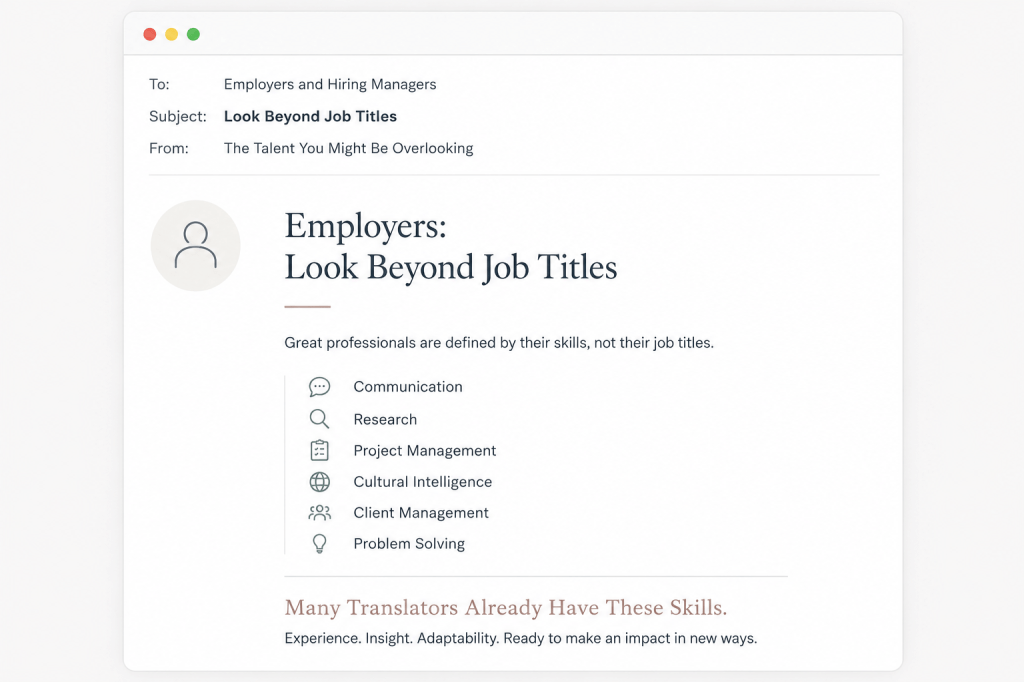
When employers recruit, they often search for candidates with specific job titles and industry backgrounds. Yet some of the most capable professionals may not fit neatly into those categories. A candidate’s competence should not be defined by their job title but by their transferable skills and expertise. Many translators and interpreters have spent years developing…
-
A Patchwork of Insecure Jobs or Diversification? What the Positive Language of Portfolio Careers Might Be Obscuring

Many translators and interpreters today do not have a single career. They have a patchwork. A few hours of translation here. Some teaching there. A training session next week. A short editing project next month. A handful of regular clients and intermediaries, a stream of one-off assignments, and a constant search for the next opportunity.…
-
Language Justice Reading List

The list includes articles I have written on the topics of equality and labour rights for interpreters and translators, including empirical research, policy analysis, and critical commentary. They are grouped by theme rather than method, and some contributions appear in multiple categories. The importance of justice and fairness extends beyond the translation industry. As economist…

