
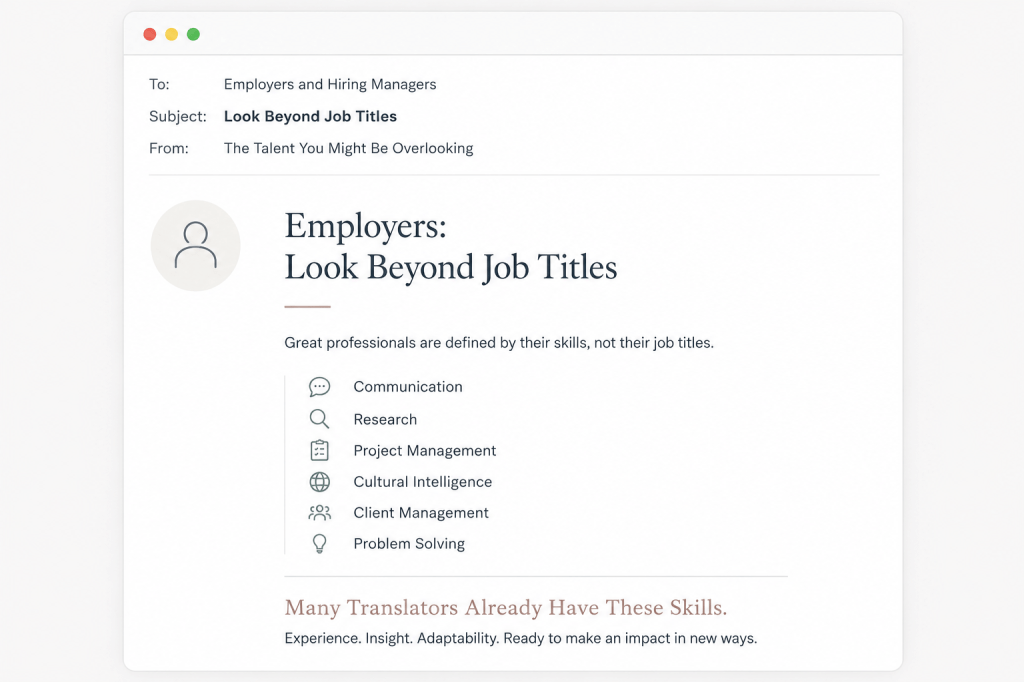
When employers recruit, they often search for candidates with specific job titles and industry backgrounds. Yet some of the most capable professionals may not fit neatly into those categories.
A candidate’s competence should not be defined by their job title but by their transferable skills and expertise. Many translators and interpreters have spent years developing capabilities including strong communication, analytical thinking, research ability, project management, stakeholder engagement, cultural awareness, attention to detail, and independent problem-solving.
Despite the value of their expertise, translators and interpreters are also dealing with increasing price pressure, the concentration of power among large intermediaries, the growth of low-cost online marketplaces, declining rates, business models that often prioritise volume and cost reduction over expertise and quality, and technological developments including machine translation and AI.
Many translators and interpreters are actively exploring new career paths. The challenge is not a lack of skills but a lack of recognition. I am writing this article to highlight that, when their expertise is viewed through the narrow lens of language work, employers may overlook the wider professional value they can offer. If your organisation values skills over labels, there is a highly skilled talent pool that deserves closer attention.
Translation and Interpreting Skills
Successful language professionals are communicators, researchers, analysts, cultural mediators, project managers, and subject-matter specialists. They routinely work with complex materials in fields such as law, healthcare, technology, engineering, finance, education, public policy, and international business. They must understand specialised terminology, evaluate sources, conduct research, communicate clearly, and produce work that meets demanding quality standards.
Many also work as freelancers, managing multiple clients, competing priorities, budgets, contracts, deadlines, and business operations simultaneously. These are not entry-level responsibilities. They require discipline, resilience, judgement, and a high degree of professional autonomy.
A Social Responsibility Opportunity for Employers
Technological and economic change affects every industry eventually. When it does, experienced professionals should not be expected to discard years of expertise and begin again in entry-level jobs. Employers have an opportunity to help address this challenge while also strengthening their organisations.
Many translators and interpreters possess skills that are directly relevant to roles involving:
- Communications and content
- Customer success and client services
- Research and analysis
- Knowledge management
- Project coordination and project management
- Training and learning support
- Policy and public sector work
- Documentation and compliance
- Community engagement
- Administrative and operational support
These professionals are already accustomed to handling responsibility, managing deadlines, solving problems independently, and communicating effectively with diverse stakeholders.
The Hidden Value of Freelance Experience
Freelance experience is often underestimated during recruitment processes.
Yet successful freelancers frequently perform the equivalent of several roles at once. They market their services, build client relationships, negotiate contracts, manage projects, conduct research, deliver high-quality work, handle finances, and continuously develop their professional expertise.
These experiences cultivate commercial awareness, adaptability, initiative, self-management, and resilience—qualities that employers regularly identify as desirable.
Rather than viewing freelance experience as unconventional, employers should recognise it as evidence of professional capability and resourcefulness.
Employers who focus only on previous job titles may miss talented candidates whose experience has developed outside traditional corporate structures.
Those who look beyond labels, however, may discover professionals with exceptional communication skills, strong analytical abilities, international perspectives, and proven experience working independently and responsibly.
A Call to Employers
The translation and interpreting profession contains a wealth of experienced, adaptable, and highly capable individuals whose skills extend far beyond language work. Many are looking for opportunities to apply their expertise in new contexts. They do not need to start over from the beginning. What they need is recognition of the value they already bring.
If your organisation believes that skills matter more than job titles, now is the time to take a closer look at the talent hidden in plain sight.
About the author
Fardous Bahbouh is a researcher and broadcast interpreter specialising in labour rights and the political economy of the translation and interpreting industry. Alongside her academic research, she continues to work with agencies and production companies that value interpreters and translators and provide fair working conditions. She also runs a small translation company and does not generalise critiques of unfair intermediaries to all translation companies or agencies.
 Lingua Media Connect
Leave a comment