
Category: Uncategorized
-
Ethical Duty of Self-Care: Scene Two of Professionally Speaking

For those who haven’t met her yet, Nora is the interpreter at the centre of my forum theatre play Professionally Speaking. Nora is scrolling through LinkedIn again. She has just discovered that someone from the Association of Translation Companies (ATC), who previously co-authored academic research about finding “fair pay rates” for translators, has shared new research…
-
If I Were the Head of ITI
For almost three years, I have been researching, analysing and critiquing the Institute of Translation and Interpreting (ITI) — its public positions, its relationships with commercial actors, the narratives it promotes, the questions it asks and, sometimes, the questions I think it should be asking but isn’t. My interest is not really in ITI for…
-
Who Speaks for Academia? An Open Letter to ITI’s University Members on Due Diligence, Representation and Academic Independence

The CEO of the Institute of Translation and Interpreting (ITI) is due to speak at an upcoming Association of Translation Companies (ATC) event in a discussion framed around “academia, associations and community”. But who, exactly, speaks for “academia”? The ITI has a controversial membership structure: it offers membership to individual translators and interpreters, universities, and…
-
What Would Fair Pay for Translators and Interpreters Actually Look Like?

Translation and Interpreting Studies have documented declining rates and deteriorating working conditions, while commercial intermediaries have raised concerns about the difficulty of attracting and retaining skilled translators and interpreters. Yet a fundamental question remains largely absent from these discussions: What would actually make a rate of pay fair? Discussions of fair pay often move quickly…
-
What Happens If Translators Quit?
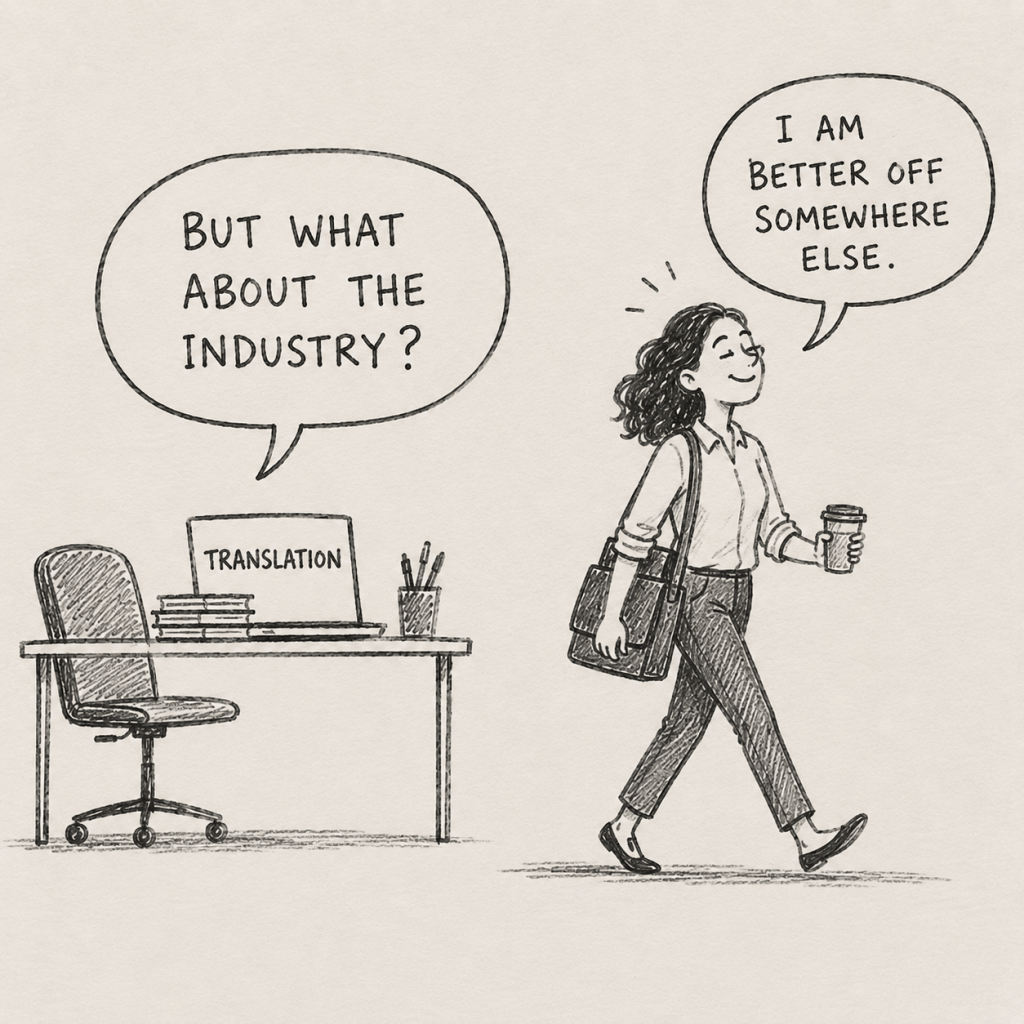
Please indulge me in a little thought experiment. Imagine that translators who can no longer earn what they consider a reasonable living from translation gradually decide: Enough. I want a secure income and a better work-life balance. I can do something else. What happens next? Some translators might be disheartened about quitting work they love.…
-
Can Industry–Academia Collaboration Find a Fair MTPE Pricing Model Without Addressing What “Fair” Means and Without Asking Translators?

I just finished reading an academic paper entitled “In search of a fair MTPE pricing model: LSPs’ reflections and the implications for translators.” The study examines machine translation post-editing (MTPE) pricing through a focus group of eight representatives of commercial intermediaries, referred to in the study as Language Service Providers (LSPs). The participating companies were…
-
Dear Translators and Interpreters, You Are Not Alone!

Last week, I watched the drama Mr Bates vs The Post Office because I was looking for inspiration, strength and resilience. As I navigate my own efforts to complete my thesis on the injustices faced by public-service interpreters, I wanted to watch the story of people who persisted in questioning a system that seemed overwhelmingly…
-
Slightly unusual advice to translators and interpreters: read Joseph Stiglitz

When I hear people talking about “loving your work,” I often feel like shouting: absolute BS! As a broadcast interpreter, I have spent many years covering wars, conflicts and some truly grim atrocities. And through my PhD, I research inequality and exploitation in the translation and interpreting industry. One aspect of doing my PhD that…
-
Interest Groups Must Not Be Allowed to Supervise Student Research or Set Research Agendas without Adequate Due Diligence

For some, this might seem like a statement of the obvious. Academic research should be intellectually independent, and students should be free to follow where their evidence leads. In Translation Studies, however, the boundaries between academic research and industry interests are becoming increasingly blurred and, in my view, increasingly concerning. And that is why I…
-
UK Universities Did Not Know an Interest Group Had Been Added to the Association of Programmes in Translation and Interpreting Studies (APTIS)

Universities are public institutions and they must be held accountable. But how do we hold them accountable for decisions made in their name when they do not even know those decisions have been made? This is one of the questions I have been left asking while investigating the relationship between UK Translation Studies and the…
-
Corporate Capture of Academic Narratives or Productive Industry–University Collaboration?

Over the past three years, my PhD research has focused on inequality in the UK’s public service interpreting sector. Through survey research, policy analysis and documentary evidence, I have been investigating what outsourcing and commercial intermediation have meant for the people who actually provide language services. The picture that emerged is deeply troubling. Public service…

