
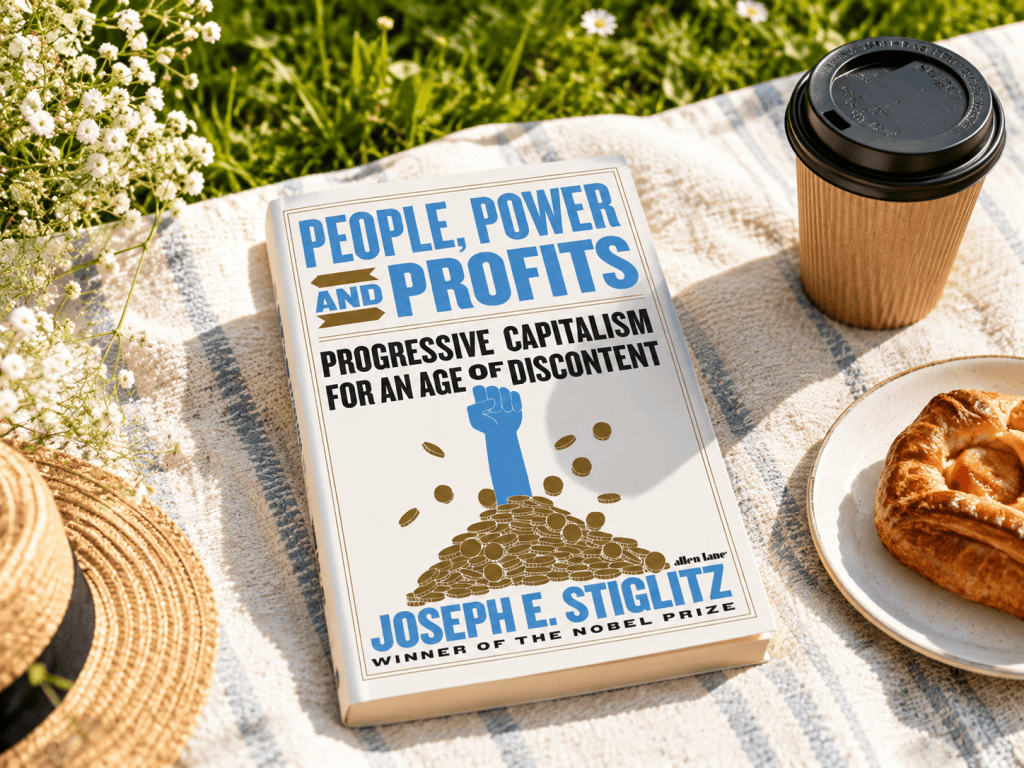
When I hear people talking about “loving your work,” I often feel like shouting: absolute BS! As a broadcast interpreter, I have spent many years covering wars, conflicts and some truly grim atrocities. And through my PhD, I research inequality and exploitation in the translation and interpreting industry. One aspect of doing my PhD that I really appreciate is reading scholars who help me make sense of power and economics, especially the work of Joseph Stiglitz.
I think translators and interpreters might find his work particularly insightful. Reading him can offer some comfort by giving us the intellectual tools to make sense of things that have been troubling many of us for years. It can also give us greater clarity about what needs to change—and why collective action matters. Because understanding our individual position sometimes requires us to understand the structures around us.
One of Stiglitz’s central arguments rests on a deceptively simple idea: inequality is not determined by some mysterious natural force called “the market.” It is shaped by institutions, laws, policies, regulations, norms and power. Stiglitz argues that markets alone are not necessarily efficient or fair. They need regulation and governance.
Stiglitz also writes about restricted choice. Many of us, because of race, gender, age, caring responsibilities or other circumstances, may find our choices constrained—what work we can accept, what we can negotiate, or what rates we can realistically ask for. Some participants in my PhD study expressed this very clearly. One asked, “Who would hire me at this age?” Another explained that they could not afford to send their child to nursery at the rates they were earning, so they were restricted to remote interpreting that paid per minute of actual interpreting. One interpreter put it simply: “I hope they allow interpreters to live from their work.” Acknowledging the structural factors shaping our choices might help us stop blaming ourselves for failures of governance.
Another idea in Stiglitz’s work that resonates strongly with me is freedom: not simply the freedom to enter into a contract, but the substantive freedom to live free from fear and want, and to enjoy a fair share of the fruits of our labour. He illustrates how increasing inequality can deprive people of those basic freedoms. He also reminds us of an old insight: freedom for the wolves can mean death for the sheep.
I find this particularly relevant to translation and interpreting. While many translators and interpreters face increasing financial insecurity, some of the largest commercial intermediaries in the language-services industry generate revenues in the hundreds of millions. Stiglitz reminds us that the important question is not simply whether wealth is being created, but who has the power to capture the fruits of that economic activity, and who bears its risks.
Through a Stiglitzian lens, the translation and interpreting industry can be understood as showing features of market failure: weak regulation, diminishing bargaining power and limited protections for practitioners, many of whom work as self-employed freelancers. Genuine self-employment can offer valuable freedom and flexibility. But increasing numbers of practitioners report losing that freedom and flexibility while still not benefiting from many of the protections available to employees or workers, including minimum-wage guarantees and protection against unfair dismissal.
Even more seriously, fragmented and outsourced working arrangements can make responsibility for our health, safety and wellbeing remarkably difficult to locate—even when interpreters are working in physically or emotionally demanding environments.
Think about the COVID-19 pandemic. Interpreters were working in hospitals and other healthcare settings, communicating face-to-face with patients during an unprecedented infectious-disease emergency. How many interpreters contracted COVID while doing that work? How many died? I have tried to find the answer. As far as I have been able to establish, nobody knows because nobody appears to have systematically counted them.
How can we reverse injustices if they are not even documented and acknowledged? And that is why perhaps the most important lesson I have learned from Stiglitz is to ask: Who controls the narrative? My research revealed is that economic advantage enjoyed by commercial intermediaries is also being translated into political and institutional power. Take, for example, the Association of Translation Companies (ATC), the interest group representing translation companies—what I prefer to call commercial intermediaries.
The ATC is effing everywhere. Its website clearly states that it lobbies legislators and government on behalf of its members. It collaborates with professional organisations and academics. It initiates, participates in and even “supervise” research. It also sponsors conferences, such as the “Better Together” conference.
I acknowledge that an interest group can be expected to seek influence on behalf of its members. Indeed, the ATC appears to do this very effectively.
But who represents translators and interpreters?
Before you answer “professional organisations,” remember that the Institute of Translation and Interpreting (ITI) last month awarded the ATC an excellence award. Even the Association of Interpreters and Translators (AIT) is hosting a talk next week by the CEO of the ATC Raisa McNab on the future skills translators, interpreters and language specialists will need to remain competitive; practical ways to diversify and expand their skillsets; and strategies for ongoing professional development and adapting to industry change. For only £22.38. Do you want to throw that money into the sinkhole of the translation industry while giving the ATC even more legitimacy?
I have written repeatedly about how professional organisations might be unwittingly contributing to a shift in responsibility away from commercial intermediaries and onto individual translators and interpreters—telling practitioners to adapt, upskill, invest in training and embrace new technology, while giving far less attention to the institutions and commercial structures shaping their working conditions.
And that is why my advice is: read Stiglitz. Borrow his books from your local library. Start with The Road to Freedom or People, Power, and Profits. Then think. Think about the choices available to you, but also about what might be restricting those choices. Think about whether you still want to be part of this industry, or whether your skills and experience might give you a better life somewhere else. I am not going to tell you to adapt, upskill, diversify or find a way to remain “competitive”. That choice is yours.
If you decide to stay, remember that we need to reclaim the narrative. Hold professional organisations, universities and policymakers accountable. Make end clients aware of unfair and potentially exploitative practices in the industry. And, above all, resist the idea that every structural problem can be solved by asking individual translators and interpreters to adapt a little more.


Leave a Reply