
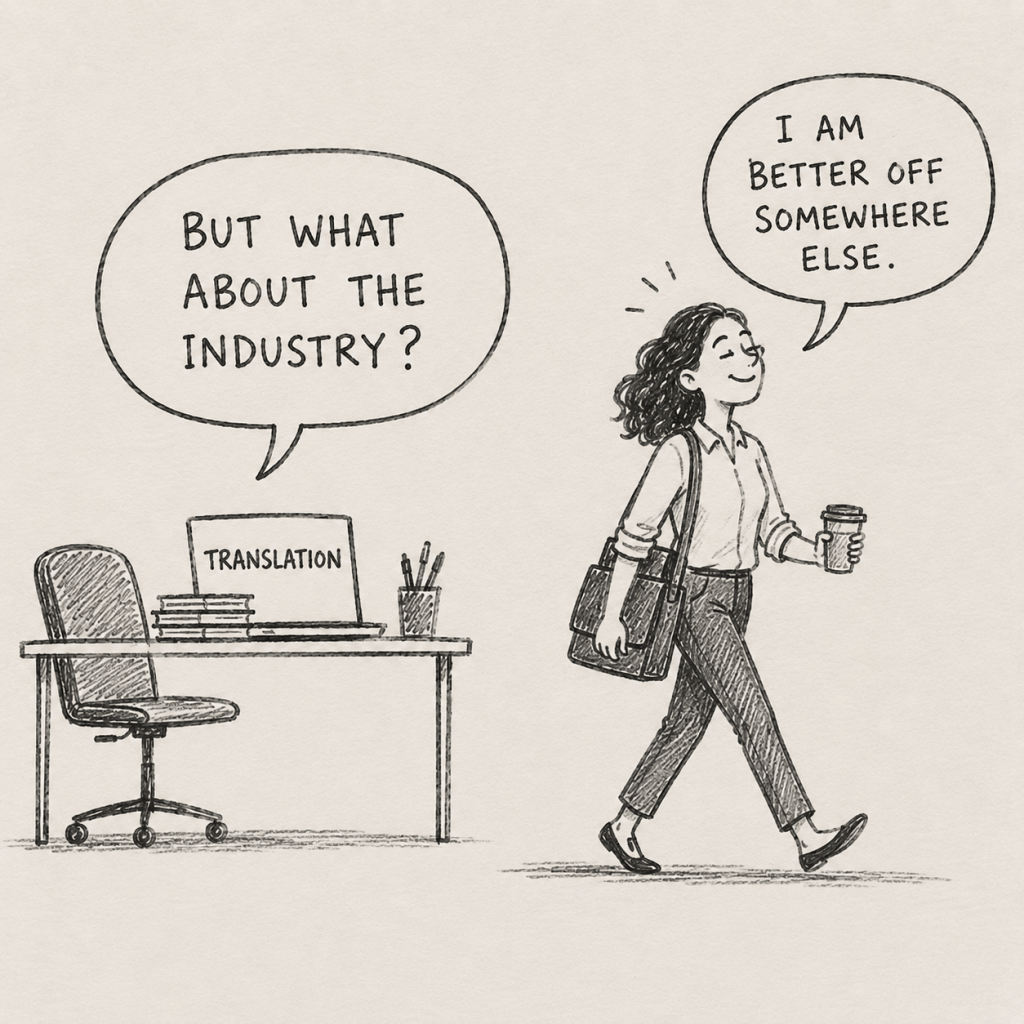
Please indulge me in a little thought experiment. Imagine that translators who can no longer earn what they consider a reasonable living from translation gradually decide: Enough. I want a secure income and a better work-life balance. I can do something else.
What happens next? Some translators might be disheartened about quitting work they love. Others might be relieved to find better employment elsewhere. Some might retrain or pursue an academic career. Others might continue translating on the side for extra income. Or they might do something entirely different.
But wait. What would happen to the commercial intermediaries that rely on translators’ labour to make a profit? Would they be forced to increase rates and improve working conditions to persuade translators to stay? Would they have to stop treating translators as disposable, interchangeable units? Or would they recruit more translators abroad, increase their reliance on AI and machine translation, or find some other way to reduce their dependence on UK-based professional translators?
I am asking because I repeatedly come across perplexing warnings in Translation Studies that deteriorating remuneration and working conditions may cause translators to leave, creating recruitment and retention problems for the industry. One recent paper goes further, explicitly raising concerns about the sustainability of the translation industry and the loss of its “human capital”.
And this made me wonder: why are we assuming that translators leaving would necessarily be a sustainability problem? And sustainable for whom?
Misplacing sustainability concerns
The paper that prompted these thoughts is The Good Life? Exploring Human Capital Sustainability Among UK Freelance Translators by Joseph Lambert, JC Penet and Callum Walker.
The article begins with the familiar Brundtland definition of sustainable development as meeting “the needs of the present without compromising the ability of future generations to meet their own needs”. The fuller Brundtland framework centres people’s needs, livelihoods and opportunities for a better life.
Applied to translators, I would have expected some fairly obvious questions. Can translators meet their needs and build financial security from their work? Can they take time off, care for their families and eventually retire? Can the next generation reasonably expect to build sustainable livelihoods from translation?
But somehow the article changes the object of sustainability. The discussion moves towards “human capital sustainability”, with the authors arguing that a key question is ensuring that human capital does not migrate out of the translation industry.
If translators cannot earn enough from translation to sustain their own livelihoods, isn’t that already a sustainability problem? This is a worrying shift from whether the industry sustains the people working within it to whether those people remain available to sustain the industry.
Let us return to our thought experiment. Imagine a translator who has spent twenty years developing specialist expertise. Her rates have stagnated, work has become less predictable and she increasingly feels replaceable. Then she finds another job. It gives her a regular salary, paid holidays, sick leave and a pension. Perhaps she misses translation terribly, but perhaps she is also more financially secure and more confident about the life she can provide for her family.
From a “human capital” perspective, this is a loss for the translation industry. From hers, it might represent an improvement in the sustainability of her life.
So why should retaining her in translation automatically be the desirable outcome? I would much rather see translation become a profession in which skilled people can build secure and rewarding careers. But that does not mean individual translators should remain in deteriorating conditions because commercial intermediaries need their expertise.
Nor is it obvious that translators leaving would make the industry itself unsustainable. As our thought experiment suggests, intermediaries might respond in many ways other than improving translators’ conditions.
An industry can remain economically viable while the livelihoods of people working within it become increasingly unsustainable. Indeed, lower labour costs can benefit some actors precisely while harming others. Translators, commercial intermediaries, technology companies and purchasers participate in the same economic system, but their interests are not necessarily aligned.
The analytical leap to self-actualisation
The research also finds something many translators will probably recognise: despite all the difficulties, many still love translating. They value its intellectual stimulation, creativity, craftsmanship, autonomy and sense of professional identity.
The problem, for me, is the analytical leap from these findings to self-actualisation. The authors interpret the coexistence of positive experiences and poor job quality through a “motivation-satisfaction paradox” and assert that translators can achieve considerable self-actualisation.
But enjoying translation, taking pride in one’s craft, valuing autonomy and finding work intellectually satisfying demonstrate intrinsic motivation, meaningfulness and professional attachment. They do not, by themselves, establish self-actualisation despite unmet needs. That requires a further theoretical argument. If a translator says, I love translating, but I cannot earn enough from it to feel financially secure, we have evidence that they love their work and experience financial insecurity.
And perhaps there is no paradox to explain in the first place. People can love the substance of their work while objecting to the conditions under which it is organised and remunerated. Meaningful work and good-quality work are not the same thing.
I take issue with some Translation Studies authors repeatedly asking what will happen to the translation industry if translators’ wellbeing deteriorates so far that they leave. But perhaps we should also ask what translators’ attachment to their work has already allowed the industry to get away with. Translators bring to the economic relationship their fascination with language, pride in craftsmanship, professional identity and desire to produce excellent work. These are valuable intrinsic rewards. But could they also make poor remuneration, insecurity and declining bargaining power tolerable for longer than they otherwise would be?
If so, perhaps the more revealing question is not how translators remain fulfilled despite poor job quality, but who benefits when translators love the work enough to tolerate it?
Whose problem are we trying to solve?
This brings me to a broader concern I have been documenting for a few years: the growing proximity between some strands of Translation Studies and corporate interests. In an earlier analysis, I documented a shift from Lambert and Walker’s Because We Are Worth It (2022), which foregrounded declining remuneration, towards later work emphasising resilience, self-actualisation and industry collaboration. My concern is what can happen when academic research adopts industry concepts and priorities without sufficient critical distance.
The Routledge Handbook of the Translation Industry (2025), for example, includes a chapter by Raisa McNab, CEO of the Association of Translation Companies (ATC), in which translators are described as “resources” within project-management workflows. Without sufficient critical interrogation, such managerial framing risks turning translator remuneration into a cost variable to be optimised rather than a question of fair compensation, sustainable livelihoods and labour rights.
I have also questioned the role of professional bodies in legitimising particular narratives. The Institute of Translation and Interpreting (ITI), whose membership includes individual practitioners as well as universities and corporate members, gave Lambert and Walker an Award for Excellence last year for Thriving or Surviving. An award does not endorse every argument made by its recipient, but professional recognition confers legitimacy. Given that Thriving or Surviving documented serious financial insecurity while arguing that translators could nevertheless achieve “self-actualisation”, I would have hoped for greater critical interrogation of that framing. What are the consequences of telling a financially struggling profession that it can nevertheless self-actualise? This year, the same award went to the ATC.
There is one final reason I find this uncomfortable. The Chasing Status project underpinning The Good Life? was supported through a British Academy/Leverhulme scheme that includes public funding. Public funding does not require researchers to reach any particular conclusion. But it does make this a legitimate question of public interest: when research documents skilled workers struggling financially, why does the analytical concern shift towards whether the industry can retain them as “human capital”, rather than whether those workers can sustain decent livelihoods?
This is why I am beginning to wonder whether something is confusing the ethical compass of some strands of Translation Studies. The problem is not that researchers cannot see translators’ financial insecurity. They can. My concern is what happens analytically after they see it!
Low pay becomes a problem of retention. Poor job quality coexists with “self-actualisation”. Translators contemplating leaving become a loss of “human capital”. Unsustainable livelihoods become a threat to the sustainability of the industry. I encountered a similar problem in another recent industry–academia study examining a “fair” MTPE pricing model. The study acknowledges low pay and problematic pricing practices, yet does not define what fair means or include translators themselves among the research participants.
Perhaps these are separate theoretical choices. But taken together, I think they justify asking a much simpler question: When translators are struggling financially, whose problem do we understand this to be?
Is the problem that highly skilled professionals cannot build secure lives from their work?
Or is the problem that, if their conditions deteriorate far enough, they may leave and the industry will struggle to replace them?
The second problem may certainly matter. But we should be careful that concern for the sustainability of the translation industry does not displace concern for the sustainability of translators’ lives.
I raise these questions from a political-economy perspective: one concerned not only with whether an industry survives, but with how its markets are structured, who holds bargaining power, how gains and risks are distributed, and whose welfare is prioritised by the institutional arrangements that govern it.
About the author
Fardous Bahbouh is a researcher and broadcast interpreter specialising in the political economy of the translation and interpreting industry. Alongside her academic research, she continues to work with agencies and production companies that value interpreters and translators and provide fair working conditions. She also runs a small translation company and does not generalise critiques of unfair intermediaries to all translation companies or agencies.


Leave a Reply