
Tag: history
-
Who the Hell Is Checking the NHS Bills?

Remember back in 2013, the UK government uncovered a major scandal involving two private security companies, G4S and Serco, which had been contracted to provide electronic monitoring services? Investigations revealed that the companies had charged the Ministry of Justice for monitoring people who were no longer subject to electronic tagging, including individuals who had returned…
-
We Seriously Need to Talk About Alternatives: Continuing My Ethical Plea to Translation Studies
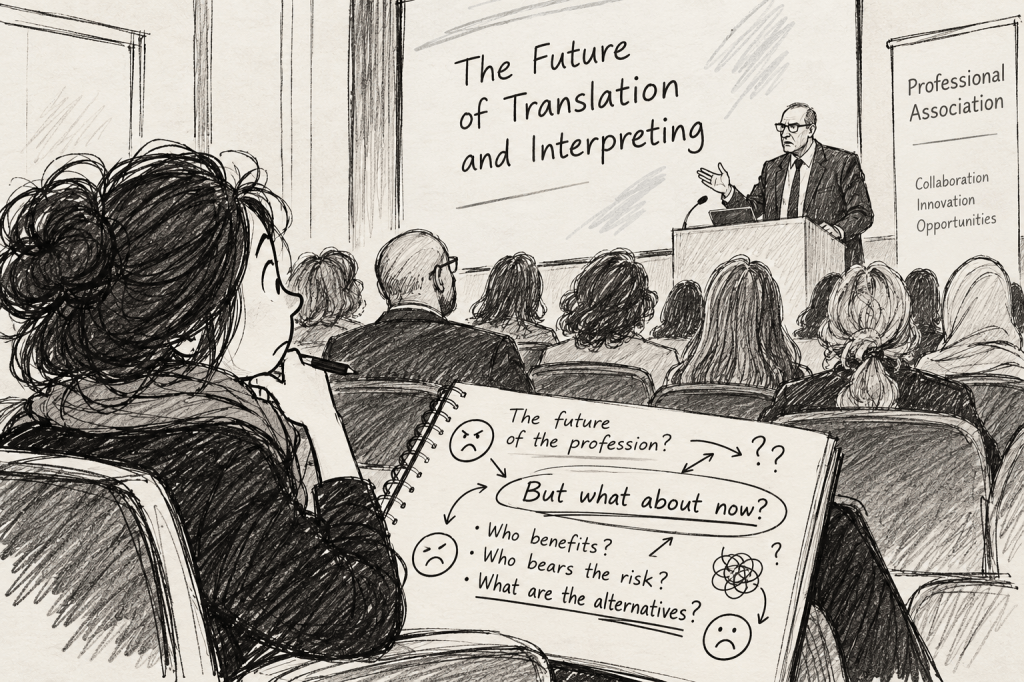
Dear Translation Studies, I don’t want you to only prepare translators and interpreters for the future. I want you to help interrogate the present and invite our collective scholarly genius to make the present liveable as we continue to envision the future. My previous love letter borrowed a simple proposition from Joseph Stiglitz: creating a…
-
What Would a Good Translation Industry Look Like?

In a previous article, I explored a deceptively simple lesson from Joseph Stiglitz: markets are not natural phenomena. They are shaped by institutions, laws, policies, regulations, norms and power. But that insight raises another question. If markets are shaped by us, how should we shape them? Stiglitz’s work offers valuable normative insights for thinking about…
-
What does Translation and Interpreting Studies know about the economic lived realities of translators and interpreters?

I am a PhD researcher investigating inequality in outsourced public service interpreting in the United Kingdom. My research has documented low remuneration, economic insecurity, weak employment protections, diminishing bargaining capacity and inadequate health and safety protections among public service interpreters. It also examines the outsourcing arrangements within which these inequalities occur, and how those arrangements…
-
Write to Your MP: Fair Work and Equality in Public Supply Chains

In collaboration with the NUPIT-National Union of Professional Interpreters and Translators, I have prepared this letter for translators and interpreters who want to ask their MPs to take action on fair work and equality in publicly funded supply chains. Public money should not fund exploitation. Translators and interpreters working across the NHS, courts, police, local…
-
Who Speaks for Academia? An Open Letter to ITI’s University Members on Due Diligence, Representation and Academic Independence

The CEO of the Institute of Translation and Interpreting (ITI) is due to speak at an upcoming Association of Translation Companies (ATC) event in a discussion framed around “academia, associations and community”. But who, exactly, speaks for “academia”? The ITI has a controversial membership structure: it offers membership to individual translators and interpreters, universities, and…
-
What Would Fair Pay for Translators and Interpreters Actually Look Like?

Translation and Interpreting Studies have documented declining rates and deteriorating working conditions, while commercial intermediaries have raised concerns about the difficulty of attracting and retaining skilled translators and interpreters. Yet a fundamental question remains largely absent from these discussions: What would actually make a rate of pay fair? Discussions of fair pay often move quickly…
-
Who Is a Language Service Provider, and Who Are the Intermediaries?

One of the persistent sources of confusion in the translation and interpreting profession—and in Translation and Interpreting Studies—is the way we use the term language service provider (LSP). For years, the term has been used to describe commercial agencies and multinational companies that sit between clients and translators or interpreters. Yet this terminology deserves reconsideration.…
-
Draft Ethical Principles for Professional Organisations

Over the past three years, I’ve spent a great deal of time analysing the role of professional organisations in the translation and interpreting sector as part of my research on the ethical governance of precarious labour. I’ve written extensively about what I believe is going wrong. I’d now like to shift the conversation towards what…
-
Collaboration or Exclusion? Why is Translation Studies Still Ignoring Power and Legitimacy?

As someone researching equality, diversity and inclusion (EDI), with a focus on labour rights and working conditions in the translation and interpreting industry, I have been deeply concerned by growing calls for industry–academia collaboration within Translation Studies. The value of collaboration is often asserted rather than supported by evidence or logical arguments. These collaborations are…
-
A Patchwork of Insecure Jobs or Diversification? What the Positive Language of Portfolio Careers Might Be Obscuring

Many translators and interpreters today do not have a single career. They have a patchwork. A few hours of translation here. Some teaching there. A training session next week. A short editing project next month. A handful of regular clients and intermediaries, a stream of one-off assignments, and a constant search for the next opportunity.…

