
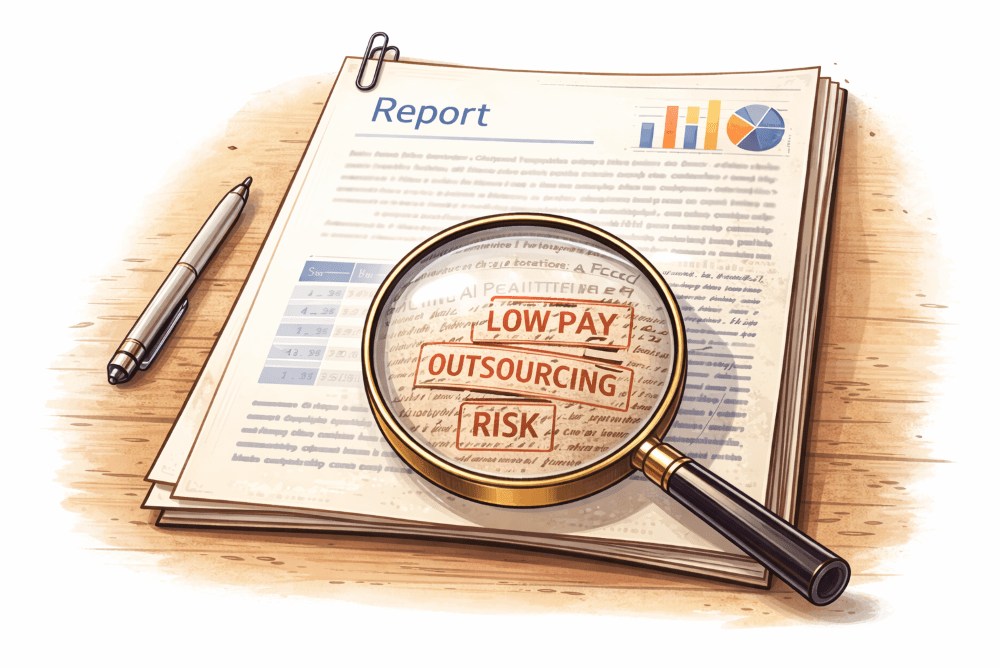
This is not a neutral reflection. It is a deliberate intervention.
As an academic researcher, I once again feel compelled to speak out. Over the past few years, I have watched a particular narrative about the translation and interpreting industry take shape across academic publications, public events, and institutional collaborations. It is a narrative that presents the industry as dynamic, innovative, and collaborative—while consistently muting or marginalising the lived realities of translators and interpreters who are struggling with low pay, financial insecurity, diminishing bargaining power, and intensifying pressures linked to technological change, including platformisation, surveillance, and datafication.
I am writing this after watching the recording of the event “Studying Translation in the Age of AI: Why and How”, organised by the University of Surrey. The event brought together academic scholars and institutional representatives, including the CEO of the Association of Translation Companies (ATC), Raisa McNab, who also serves as Secretary General of the European Union of Associations of Translation Companies (EUATC). The heads of the Chartered Institute of Linguists (CIOL) and the Institute of Translation and Interpreting (ITI) were also present. This post is a normative choice: an attempt to disrupt what I see as the growing normalisation of industry-aligned narratives within academic spaces and professional organisations, and to ensure that these dynamics cannot later be framed as unknown, unintended, or invisible.
What I find particularly frustrating is that this is not new. I have had extended correspondence—and in some cases direct conversations—with several of the speakers. Yet the same framing persists. Across the event, the discussion focused on familiar concerns: the advancement of AI and machine translation, the need for professional adaptability, and the importance of aligning education with industry needs. These are not insignificant issues. But what is striking is not what is said—it is what is left out. There is very little sustained attention to the material conditions shaping translators’ lives: stagnant or declining pay, fragmented and insecure work, the effects of outsourcing (especially in public service contexts), and the growing power asymmetries between individual translators and large intermediaries who control work allocations.
Most importantly, the discussion avoids asking the most basic questions: who benefits from the current structure of the industry, and who bears the cost? Who sets rates of pay? Who determines working conditions? Where does responsibility lie?
Instead, the problem is subtly reframed. Risks and responsibilities are transferred to translators. The discussion shift to how translators can adapt—how they can upskill and meet market demand—rather than a question of how the market itself is structured in ways that produce inequality and precarity. As Isabell Lorey puts it in her book State of Insecurity:
If we fail to understand precarization, then we understand neither the politics nor the economy of the present.
I have written extensively on these concerns. This includes my analysis of ethical risks of translation academics “collaborating” with the industry without adequate critical engagement and objective analysis, and my reflections on the ethical tensions and power asymmetries in industry–academic collaboration. I have critiqued the “Better Together” conference organised by the Association of Programmes in Translation and Interpreting Studies in the UK and Ireland (APTIS), held at UCL in November 2025 and sponsored by the same industry actors mentioned above. The “Better Together” conference was promoting collaboration and adaptability of individual translators, rather than highlighting the crucial fact that good translation jobs require good translation companies, legal protections and social dialogue that does not obscure financial insecurities, precarization and potential exploitation. In addition, I have written about Confronting Critical Blind Spots in Sustainability Discourse in Translation Studies. And yet, the same pattern repeats.
What is most striking is that the same excuses keep getting repeated. For example, I critiqued the report titled “The Strategic Case for Languages in UK Higher Education,” published in partnership between the Association of Translation Companies (ATC), the Chartered Institute of Linguists (CIOL), and the Institute of Translation and Interpreting (ITI), for excluding financial realities from key policy documents. I was told by the head of ITI that translators’ rates of pay are “discussed elsewhere.” Interestingly, I was told the exact same phrase by the CEO of ATC. And this is the problem I am calling attention to. When the person heading an organisation funded by translators’ membership fees echoes the same excuse as the person representing corporate interests, then there is something drastically wrong.
Does anyone have a page number, a meeting link or a postcode for where these conversations are actually taking place? After nearly three years of searching, I have yet to find them. What I have found instead is a corporate-aligned narrative that keeps getting reproduced and amplified. While researching these issues over the last three years, I have also observed that whenever the ATC is present in a collaboration or event, there is very little questioning of the role and responsibilities of the owners and executives of translation companies, who ultimately control rates of pay and working conditions. I would genuinely appreciate it if anyone could direct me to examples that challenge this observation, in order to help me avoid overgeneralisation. That is why I have repeatedly called for an honest dialogue about how to make the translation industry fairer.
However, even after repeated interventions, I sometimes feel like a canary in the coal mine. Yet rather than engaging with the substance of the critique, the response can shift towards challenging the legitimacy of speaking out. This, in itself, is revealing.
Therefore, I am deeply concerned by the continued involvement of organisations such as ATC in the event of the Surry University. The interest group play a significant role in shaping a constructed narrative of the translation industry and the broader discourse around what counts as legitimate knowledge in the field. Their presence lends authority to particular ways of talking about the industry. What is being reproduced—across events, reports, and collaborations—is a reassuring narrative: the industry is evolving, “opportunities” exist, collaboration is key, and the future belongs to adaptable professionals. But this framing comes at a cost. It risks obscuring the ethical responsibilities of commercial actors, normalising outsourcing practices known to depress wages and working conditions, and reinforcing a version of the industry in which structural problems are softened or displaced. The result is a consensus-oriented space where critique exists but is carefully contained. Even when issues such as fair pay are mentioned, they are often framed as matters of advocacy or individual concern, rather than as central analytical problems requiring structural explanation.
Additionally, inviting established linguists in senior industry positions—such as Lucio Bagnulo at Amnesty International, Giulia Tarditi at Revolut, and Xiaojie Zhang at the International Maritime Organization—can create a powerful but potentially misleading narrative if their contributions are not critically contextualised. Their perspectives are valuable, but their career trajectories are often exceptional rather than representative of the broader labour market. When these accounts are presented without sustained engagement with structural constraints, such as extremely limited full-time job opportunities, outsourcing practices, pay conditions, and job precarity, students may be exposed to a partial view of the profession.
This dynamic reflects a form of survivor bias: those who remain visible are typically those who have managed to secure stability or advancement, while the experiences of those who struggle or exit the profession remain largely absent. As a result, opportunity and resilience can appear more widespread than they are, and structural inequalities recede from view. Even when labour concerns are acknowledged, they are rarely fully interrogated. Pressures linked to AI—such as increased productivity expectations, accelerated pace, and impacts on wellbeing—are often framed as technical or inevitable developments rather than as outcomes shaped by institutional decisions and power relations. Responsibility becomes diffuse: expectations rise, but it remains unclear who sets them, who benefits, and who bears the cost.
What emerges across these discussions is a consistent pattern. Precarity is acknowledged but downplayed—something to navigate rather than confront. Translators are encouraged to be resilient, adaptable, entrepreneurial, while far less attention is given to those with the power to shape working conditions—large language service providers, platform operators, and industry intermediaries. This matters because narratives are not neutral. They shape how problems are understood, and therefore what kinds of solutions appear possible. If the issue is framed as individual adaptation, then the solution is implied to be in skills and mindset. If it is understood as structural, then the conversation must turn to power, regulation, labour rights, and accountability. At present, that second conversation remains sidelined.
This, in turn, raises a broader question about the role of academia. Is it to describe the world as presented by dominant actors, or to interrogate the structures that produce inequality—even when that is uncomfortable? For me, the answer is clear. Academia is not simply about amplifying convenient narratives; it is about producing knowledge that serves the public good. That includes the responsibility to speak truth to power, not just to engage with it and amplify its rhetoric.
I am aware that writing in this way may be perceived as contentious. But this is not about individuals; it is about a pattern repeated across multiple contexts. Financial insecurity is increasingly documented in academic research, yet often obscured or naturalised as if it were inevitable. In my own PhD research, a significant proportion of public service interpreters reported that they do not earn enough to meet their basic needs. This is not an isolated issue, but a structural condition with profound implications for dignity, wellbeing, and rights. Making this visible is therefore essential—because once visible, it becomes harder to dismiss, or to claim that “we did not know.”
If collaboration between academia and industry is to be meaningful, it cannot be treated as an unquestioned good. It must be conditional, transparent, and explicitly oriented towards improving labour conditions. Otherwise, there is a real risk that academic work—however unintentionally—contributes to the normalisation of the very inequalities it should be examining. There is also a broader question that remains largely unaddressed: what happens to those who are displaced or marginalised by technological change and deepening precarity? This cannot be answered through narratives of adaptability alone.
I also want to be clear about where I am coming from. I studied political science and trained in journalism, and I continue to work as a broadcast interpreter covering major international events, alongside my academic research. These experiences shape how I understand knowledge, power, and responsibility. In journalism, credibility is not built through alignment, but through questioning, verification, and a commitment to getting as close as possible to the truth. It requires challenging authority and resisting the amplification of convenient narratives. Academia shares that responsibility. It requires critical distance from powerful actors, openness to disagreement, and a willingness to examine whose interests are being served. If it loses that, it risks becoming something else entirely.
For that reason, I choose to intervene and to speak out. I raise concerns and I hope to find answers to these urgent questions:
1. Is it acceptable to discuss the impact of AI without addressing the intensifying financial insecurity many translators and interpreters already face?
2. Is it enough to assert optimism without also highlighting the risks?
3. Is it enough to reassure current and future translators that their skills are “still needed”—without asking whether the market is willing to pay for those skills?
4. When we emphasise adaptability, skills, and professional identity, are we shifting attention away from deeper questions about power, responsibility, and how value is distributed?
5. Why does the same narrative keep getting repeated across events, reports, and collaborations?
6. Why invite a representative of translation companies at UK and European level without asking what they are doing to ensure fair pay and decent working conditions?
7. Why include speakers from organisations that rely on translation and interpreting without questioning their employment protections and supply chain oversight?
8. If many of us refuse to buy jeans or trainers produced in sweatshops, why would we accept content or audiovisual material produced under labour conditions where translators struggle to make ends meet?
9. Why emphasise that AI cannot replicate human judgment without questioning the accuracy of work produced under extreme conditions of low pay and overwork?
10. Why are translators’ fundamental rights reduced to matters of “advocacy,” rather than being treated as central objects of structured, systematic investigation into systemic failures?
11. Is it intellectually honest to continue emphasising the benefits of translation degrees without being transparent about the precarity many graduates may face, and the opportunity costs?
12. What happened to balanced and impartial academic analysis that engages both advantages and disadvantages—and includes the perspectives of both supporters and critics—especially when discussing issues that risk corporate capture of academic narratives or add financial burdens on translators through internships?
13. And ultimately—whose interests are being served by the way these conversations are framed?
I would genuinely welcome responses, especially from those who disagree!
About the author
Fardous Bahbouh is a Researcher and Consultant specializing in Labour Rights, Public Policy, and the Political Economy of the Translation Industry.


Leave a Reply