

In a recent article, economist Mariana Mazzucato argues that achieving good economic growth in the UK requires getting public-private partnerships right by ensuring fair sharing of both risks and rewards. Mazzucato highlights the historical problem in the UK, where public-private partnerships often lead to the state overpaying while the private sector underperforms. The same issue is evident in the current system for outsourced court interpreting, and it raises an important question: Shouldn’t the private company contracted to provide court interpreting be held more accountable for the quality of the services?
This question of equitable distribution is particularly important when public services are outsourced. Who receives the rewards from public spending, who carries the risks, and what responsibility does government retain for the people whose labour ultimately delivers those services?
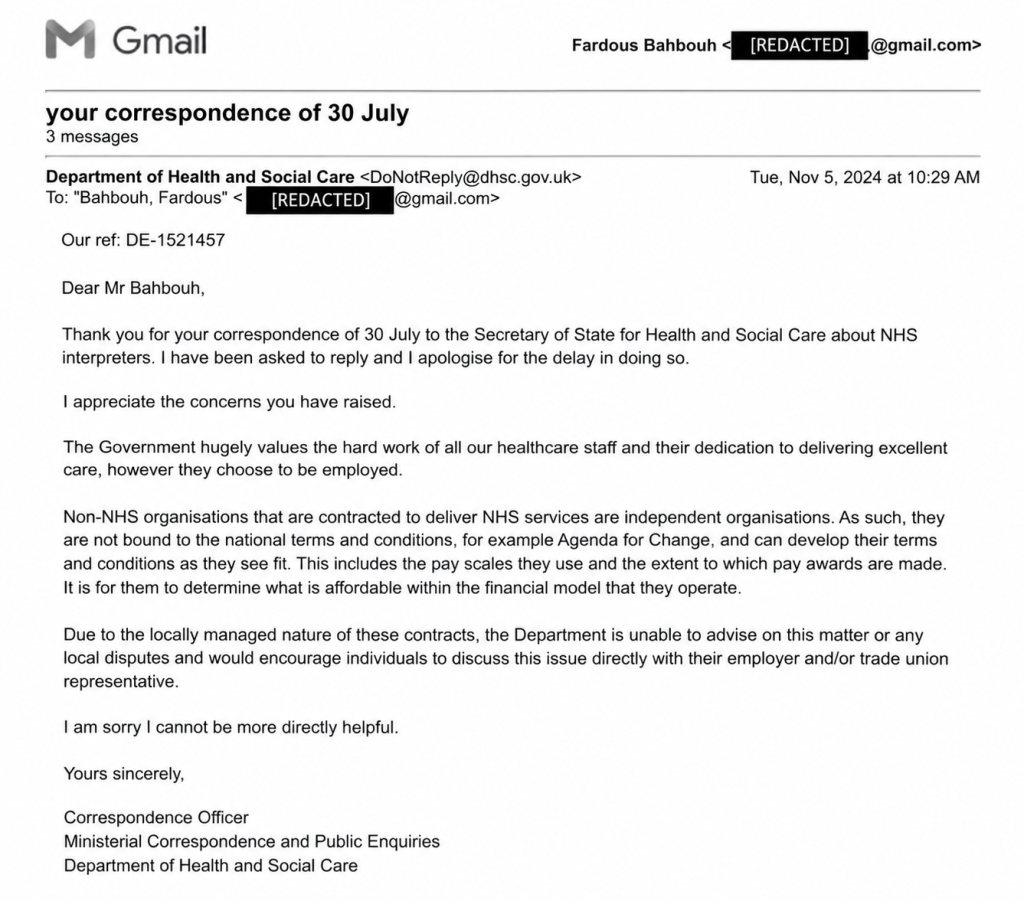
In November 2024, I received a revealing response from the Department of Health and Social Care after raising concerns about the pay and working conditions of NHS interpreters.
The Department told me:
“Non-NHS organisations that are contracted to deliver NHS services are independent organisations. As such, they are not bound to the national terms and conditions, for example Agenda for Change, and can develop their terms and conditions as they see fit.”
It added:
“It is for them to determine what is affordable within the financial model that they operate.”
This gets to the heart of the problem.
Public money pays for the service, but once that service is outsourced, decisions about how much of that money reaches the workers delivering it can be left to the financial models of private organisations.
That raises a simple question: if government does not determine what workers in its outsourced supply chains are paid, should it at least require transparency about where public money goes and ensure that the conditions it finances are not exploitative?
This matters far beyond interpreting. Outsourced workers deliver publicly funded services across healthcare, justice, social care, education and many other areas. Women, migrant workers and other groups already experiencing labour-market disadvantage are strongly represented in many of these workforces.
The issue is therefore not simply how much government spends. It is how the value created through public expenditure is distributed, who bears the risks of outsourcing, and who is accountable for the consequences.
A fairer model of public-private partnership requires more than asking whether government obtained a service at an acceptable price. We also need to ask who captured the rewards, who carried the risks, and whether public spending created public value throughout the supply chain.
About the author
Fardous Bahbouh is a researcher and broadcast interpreter specialising in the political economy of the translation and interpreting industry. Alongside her academic research, she continues to work with agencies and production companies that value interpreters and translators and provide fair working conditions. She also runs a small translation company and does not generalise critiques of unfair intermediaries to all translation companies or agencies.


Leave a Reply