

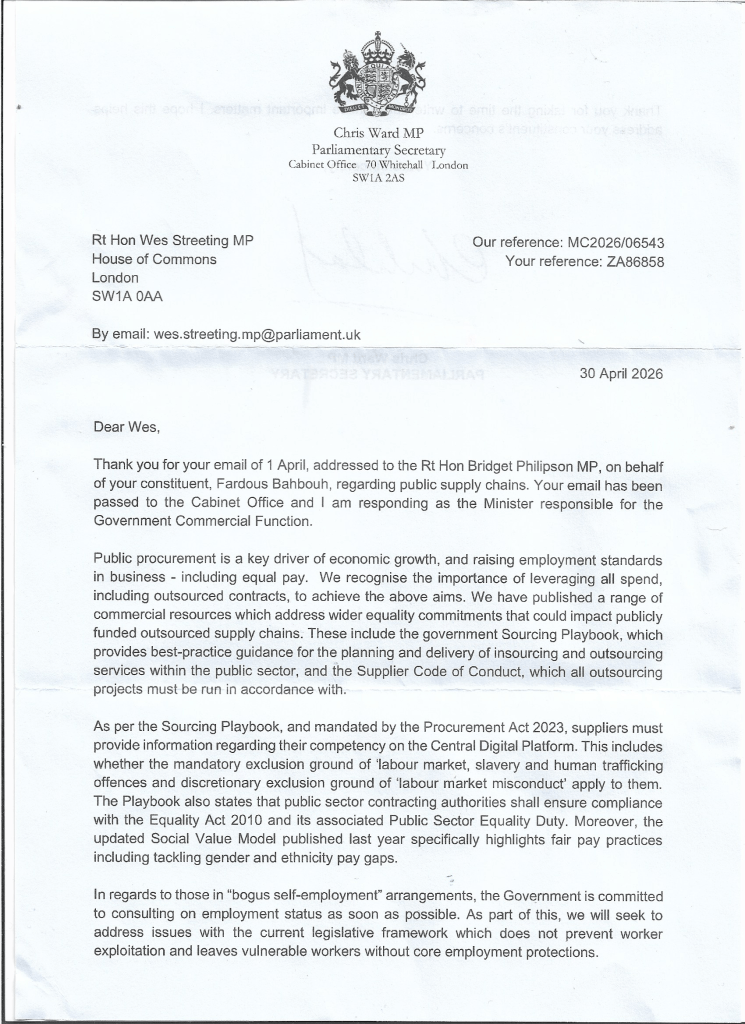
I received a ministerial reply from the Cabinet Office in response to concerns I raised about public supply chains, outsourcing, equality obligations, and precarious labour arrangements affecting interpreters and other workers in publicly funded services. A copy of the correspondence is included at the end of this article. I am very grateful to my MP, Wes Streeting, and his team for taking my concerns seriously and raising them with the Government on my behalf.
The response was issued following my open letter to the Secretary of State for Education and Minister for Women and Equalities, Bridget Phillipson MP, in which I urged the Government to publish an action plan to prevent exploitation within public supply chains.
The correspondence contains a striking admission.
In relation to “bogus self-employment” arrangements, the ministerial response states that the current legislative framework
does not prevent worker exploitation and leaves vulnerable workers without core employment protections.
This statement matters far beyond the interpreting and translation sector. It is an official acknowledgement that the current legal framework contains significant gaps in worker protection, including within publicly funded outsourcing and procurement systems that rely on private corporations, subcontracting chains, and precarious labour models. These current systems are fundamentally limited in their ability to protect workers.
Findings from my own PhD research on UK outsourced public-service interpreting identify persistent patterns of low pay, financial insecurity, and challenging working conditions among interpreters operating within such outsourced arrangements. The research also highlights a lack of basic health and safety considerations, alongside the growing role of digital technologies that further intensify precarity and weaken workers’ bargaining power.
These findings are consistent with existing academic literature and empirical research on working conditions within the translation industry. For example, a recent study documented poor job quality and intensifying financial insecurity among UK translators. Likewise, a recent study on audiovisual translation in Europe has documented comparable dynamics of increasing precarity, including fragmented work organisation and downward pressure on fees.
Taken together, this body of evidence suggests that the conditions described in this article reflect broader and well-documented structural trends in translation and interpreting labour markets across the UK and Europe.
These are not isolated contractual disputes. They are structural outcomes of how labour is organised and procured.
The significance of this ministerial correspondence lies not only in what it explicitly states, but also in what it implicitly confirms: worker vulnerability is not an accidental by-product of the system. It is embedded within the architecture of outsourcing itself.
Repoliticising Translation Labour
For too long, translation and interpreting labour has been depoliticised.
Language work is often framed through narratives of flexibility, entrepreneurship, freelancing, contractor autonomy, platform efficiency, and market responsiveness. These narratives obscure the material realities experienced by workers operating within heavily outsourced public-service environments.
The individualisation of labour has weakened collective bargaining power while transferring risk away from institutions and corporate actors onto workers, including knowledge workers.
Interpreters and translators occupy a particularly revealing position within this system because language labour intersects directly with migration, race, access to justice, healthcare, asylum systems, courts, welfare administration, and public procurement. As a result, the conditions experienced by language professionals are not exceptional. They reflect wider transformations taking place across outsourced labour markets.
The issue therefore is not confined to one profession. It concerns the political economy of outsourced public services: how governments procure labour while distancing themselves from responsibility for working conditions within subcontracted systems; how formally “self-employed” workers remain economically dependent and structurally vulnerable; and how equality commitments are frequently undermined in practice by procurement regimes that fail in oversight and contract management.
The Limits of the Government’s Response
The ministerial reply references several existing frameworks, including the Procurement Act 2023, the Sourcing Playbook, the Supplier Code of Conduct, the Public Sector Equality Duty, and the Social Value Model. These are presented as evidence that labour standards and equality considerations are already embedded within procurement policy. However, such frameworks rely heavily on soft regulatory mechanisms rather than enforceable protections.
They operate primarily through guidance rather than binding obligations. They rely on self-reporting rather than independent verification, thereby leaving labour issues at the mercy of discretionary enforcement rather than automatic sanctions, and reputational incentives rather than structural accountability.
The government response does not commit to stronger enforcement mechanisms, mandatory labour audits, reform of employment-status classification timelines, enhanced protections for outsourced workers, or direct accountability frameworks for public contractors.
This reveals a central contradiction in contemporary outsourcing policy. Governments increasingly acknowledge issues such as labour exploitation, precarious work, bogus self-employment, and widening inequality, while continuing to rely on procurement systems that incentivise privatisation, cost-cutting, and the externalisation of employment risk.
The problem is not simply individual non-compliance. It is the structure of the system itself.
From Translation Labour to Wider Labour Politics
Although this discussion emerges from interpreting and translation work, which is my area of speciality, the implications extend across much broader sectors of the economy.
Similar dynamics are visible in social care, delivery platforms, higher education, logistics, hospitality, cleaning services, outsourced administration, digital platform work, and other forms of labour that often performed by young people, migrants, or women.
Across these sectors, workers are increasingly positioned in hybrid arrangements: formally self-employed in name, but economically dependent in practice. They carry the risks of self-employment without the autonomy that typically justifies it.
Meanwhile, corporates benefit from reduced liabilities, fragmented accountability, greater labour flexibility, and weakened collective organisation.
This produces a labour regime in which vulnerability is normalised while responsibility becomes diffuse.
The ministerial acknowledgement that the current framework “does not prevent worker exploitation” should therefore be understood as a recognition of a wider structural crisis in labour governance.
Theory of Change: From Individual Complaint to Collective Political Pressure
This correspondence also highlights a strategic limitation in how labour issues are currently addressed.
Individual complaints, taken in isolation, are insufficient. Outsourcing structures tend to fragment workers, isolate disputes, and reframe systemic issues as private contractual disagreements rather than collective political problems.
Meaningful change requires repoliticisation.
This involves transforming isolated grievances into shared analysis, linking sector-specific experiences to broader labour struggles, connecting procurement policy to employment rights, and reframing outsourcing as a political and democratic issue rather than a purely administrative one.
My role as an independent researcher is necessarily limited. Research can document patterns, analyse systems, expose contradictions, and create visibility. However, it cannot substitute for collective organisation.
I therefore invite interpreters and translators, trade unions, labour researchers, equality organisations, migrant-worker advocacy groups, procurement specialists, employment lawyers, public-sector workers, and campaigners concerned with outsourcing and precarious labour to continue developing this conversation collectively.
This is not solely about translation labour. It concerns the future of work across outsourced services.
It concerns whether public institutions can continue to claim commitments to equality, fairness, and dignity while relying on labour structures that, by the Government’s own admission, leave vulnerable workers without core protections.
The question is whether this admission remains a statement of recognition—or becomes a trigger for organised pressure capable of forcing structural change.
About the author
Fardous Bahbouh is a researcher and broadcast interpreter specialising in labour rights and the political economy of the translation and interpreting industry. Alongside her academic research, she continues to work with agencies and production companies that value interpreters and translators and provide fair working conditions. She also runs a small translation company and does not generalise critiques of unfair intermediaries to all translation companies or agencies.
Blog Image
Marcin Wilkowski / https://betterimagesofai.org / https://creativecommons.org/licenses/by/4.0/
Copy of the letters




Leave a Reply