
Tag: news
-
After the BBC Investigation into Death, Bodily Harm, and Exploitation: What Translator Organisations’ Responses Reveal About Representation Failures in Public Service Interpreting

This article offers a chronological review of professional representation in UK public service interpreting over the past three years. It raises questions about whether professional organisations are adequately representing practitioners’ interests or have become increasingly aligned with commercial interests. In 2023, the BBC published an investigation linking interpreting failures in healthcare settings to cases of…
-
What Does the 2026 World Cup Have in Common with Court Interpreting?

At first glance, absolutely nothing. One is a global sporting event watched by billions. The other is an essential public service that helps ensure access to justice. Yet both are increasingly governed by the same principle: dynamic pricing. The 2026 FIFA World Cup has already generated headlines because of the extraordinary cost of tickets. Unlike…
-
Are Translators Being Treated as Professionals, Entrepreneurs, or “Humans as a Service”?

Drawing on Jeremias Prassl’s concept of “Humans as a Service” (developed in relation to the gig economy) (2018), this article argues that translation work is increasingly organised in ways that combine formal independence with practical dependency. Translators are often presented as freelancers or professionals, yet in practice they operate within tightly structured systems where rates,…
-
The Government Has Admitted the Current Framework “Does Not Prevent Worker Exploitation and Leaves Vulnerable Workers without Core Employment Protections.”

I received a ministerial reply from the Cabinet Office in response to concerns I raised about public supply chains, outsourcing, equality obligations, and precarious labour arrangements affecting interpreters and other workers in publicly funded services. A copy of the correspondence is included at the end of this article. I am very grateful to my MP,…
-
This upcoming election, make ending exploitation within outsourced public services a top priority
As the UK prepares for the upcoming elections, an issue that deserves far greater public attention is the risk of exploitation within outsourced public service supply chains. Voters in Scotland and Wales will elect representatives to their national parliaments, while a number of local council and mayoral polls will take place in England. Across these…
-
Financial insecurity in UK public service interpreting: Excerpts from my PhD study

In the United Kingdom (UK), public service interpreting (PSI) is a state function mandated by legal frameworks and funded by taxpayers. However, its delivery is predominantly outsourced to private language service providers (LSPs), where interpreters’ labour is subject to market competition and cost-cutting logics. This study examines the inequalities experienced by interpreters in PSI through…
-
Urging the Government to publish its action plan to prevent exploitation within public supply chains: An open letter to the Secretary of State for Education and Minister for Women and Equalities, Bridget Phillipson MP
Dear Secretary of State, I am writing in response to the government’s recent announcement of employer action plans on the gender pay gap and menopause support, published ahead of International Women’s Day 2026. I welcome the recognition that women’s experiences at work continue to be shaped by structural inequalities, and I strongly support the aim…
-
Universities Must Learn from the Epstein Scandals: Do Your Damn Due Diligence and Protect Whistle-blowers

By Fardous Bahbouh, Researcher & Consultant on Labour Rights, Public Policy, and the Political Economy of the Translation Industry We all know it: the system is wrecked, but that should never stop us from trying to fix it. Maybe nothing can ever measure up to the horror those girls and young women lived through. The…
-
How much does the translation industry cost our society by underpaying its largely precarious workforce?
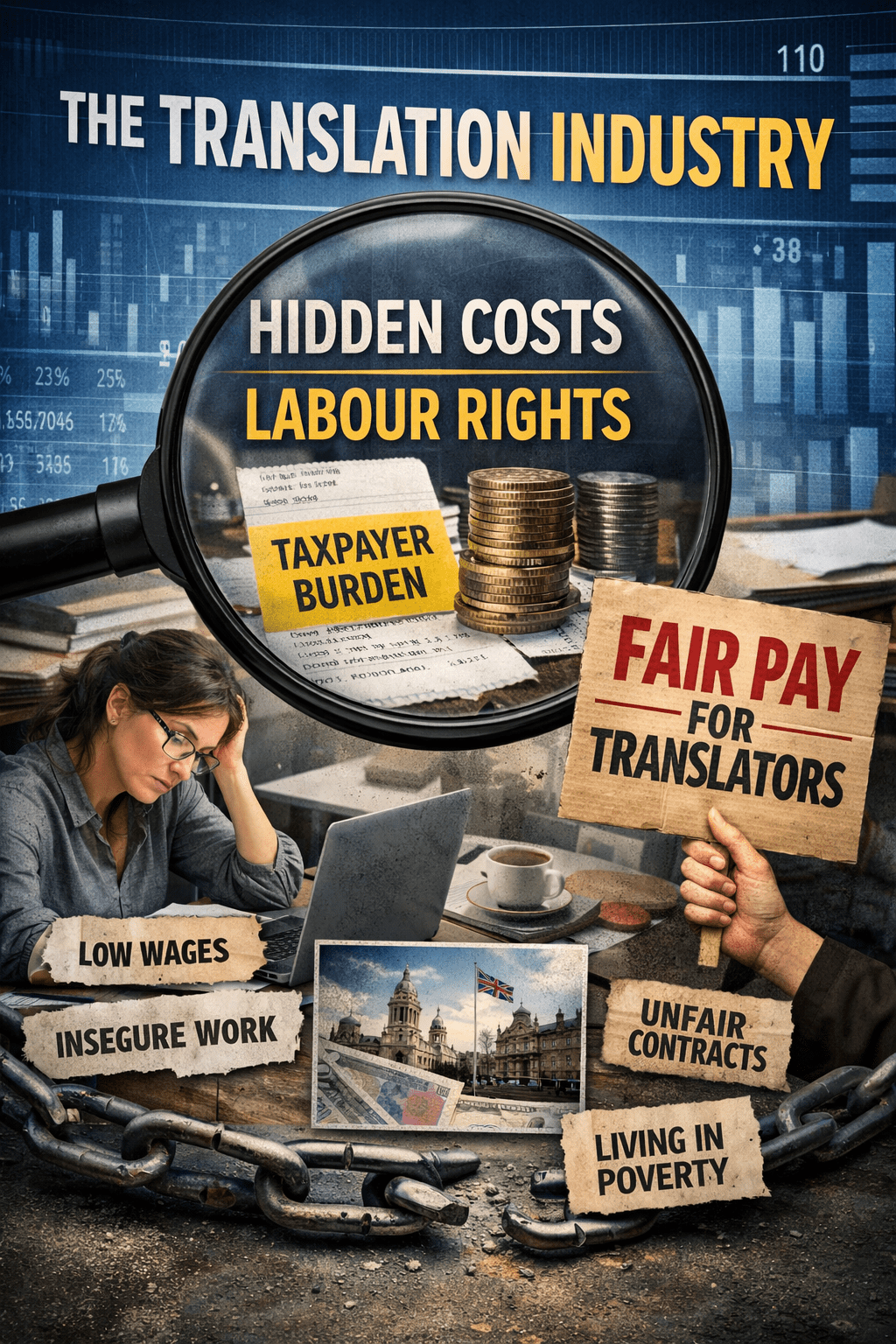
The translation and interpreting industry is frequently celebrated as a multi-billion-pound economic success story. Yet behind these impressive figures lies a far less comfortable truth. Drawing on research into working conditions across the sector, it becomes clear that many translators and interpreters — the very professionals whose labour produces the service — struggle to earn…
-
Why Are Translators’ Rights Always “Discussed Elsewhere”? Equal Opportunity, Commercial Interests and the Politics of Professional Representation

Translators’ and interpreters’ labour rights are often framed as merely a matter of low rates and consistently displaced in collaborations with commercial interests under the pretext of being out of scope or better addressed “elsewhere,” in order not to alienate stakeholders. This recurring response from academic scholars as well as translators’ institutes is not neutral.…
-
The Precariat: Critical Insights for Translators and Interpreters in an Age of Insecurity

By Fardous Bahbouh, Researcher & Consultant on Labour Rights, Public Policy, and the Political Economy of the Translation Industry In today’s fast-changing labour market, translators and interpreters are increasingly facing precarious working conditions and intensifying insecurities. The Precariat (2021) is an excellent book by economist Guy Standing that captures the lived realities of workers who…

