
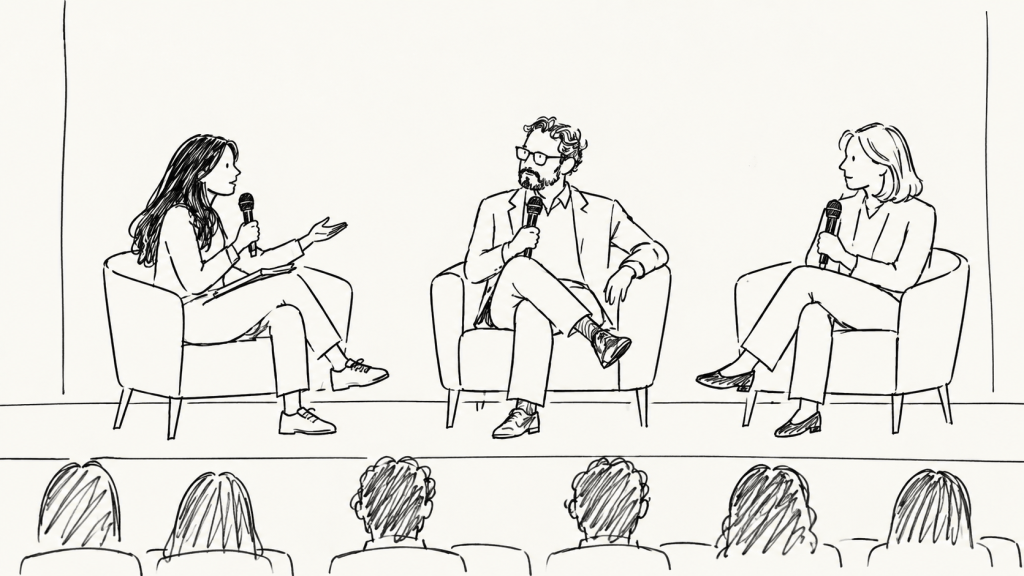
After multiple events in the UK on academia–industry collaboration, ITI CEO Sara Robertson and Dr Joseph Lambert are taking that conversation internationally to the St Jerome’s Symposium, organised by the Consortium for Translation Education Research (CTER).
If I were hosting the event, these are the questions I would ask.
1. Let’s start with the evidence.
We already have substantial empirical evidence about translators’ and interpreters’ economic lives: low or declining remuneration, financial insecurity, unpaid work, weak bargaining power, dependence on commercial intermediaries, limited social protection, and concerns about future careers and earnings.
Dr Lambert, some of this comes from your own research. In Because We Are Worth It (2022), co-authored with Callum Walker, translators’ earnings are described as a “chief ethical and pragmatic concern”.
Yet when I listen to discussions about academia–industry collaboration, I hear a great deal about skills, employability, entrepreneurship, innovation, technology, professionalisation, talent pipelines, human capital, and retention.
Why does the conversation sound so different from the empirical evidence?
Where is the money? Where is bargaining power? Where are working conditions?
And ultimately:
Whose problems are we trying to solve?
2. A simple question for both of you: What would a good translation industry look like?
Would translators and interpreters be able to earn sustainable livelihoods?
Would they have meaningful bargaining power and institutional voice?
Would commercial intermediaries have responsibilities towards the people whose labour generates the services they sell?
And crucially:
Who is responsible for making that industry happen?
Institutions cannot have agency when we discuss innovation, technology, and skills, but suddenly become powerless when we discuss remuneration and working conditions.
3. Sara Robertson, whom does ITI represent?
ITI describes itself as a trusted voice for the profession. But its membership includes both individual translators and interpreters and corporate members.
Their economic interests can conflict. A translator may seek a higher rate; a commercial intermediary may seek to control costs. Neither fact makes either party immoral. It simply creates a potential conflict of interest.
So when ITI speaks to government, universities, or the public:
Whom are you representing?
And when those interests conflict: How does ITI decide whose interests to advance?
What safeguards prevent actors with greater financial and institutional power from having greater influence?
Because representation is not simply about who gets into the room.
It is also about whose problems get onto the agenda.
4. Dr Lambert, why “human capital”?
Your more recent work uses concepts including “human capital sustainability” and retaining talent. Your work continues to address remuneration and working conditions, so I am struggling with this framing.
Why frame the problem as one of “human capital sustainability”?
There is a difference between saying:
Translators cannot earn enough.
and:
The industry may struggle to retain human capital.
In the first, the worker’s economic wellbeing is itself the problem. In the second, that wellbeing can also become a problem because the industry needs the worker to remain.
So:
What does the human-capital framing reveal—and what might it obscure?
And:
Whose sustainability are we talking about: workers, the profession, commercial organisations, or all three?
5. Can collaboration change academia too?
Joseph Stiglitz writes: “Our beliefs are affected by the beliefs of those with whom we interact” (2024, p.183).
So, Dr Lambert:
How do you know whether academia is changing industry—or industry is changing academia?
How do researchers maintain critical distance from organisations with which they repeatedly collaborate?
And perhaps the harder question:
How would we know if collaboration were shaping not only the answers academics produce, but the questions they stop asking?
6. Sara Robertson, is there room at the table for critical academics?
Academia–industry collaboration inevitably involves scrutiny as well as cooperation. Researchers may question ITI’s governance, corporate relationships, potential conflicts of interest, public narratives, or impact on practitioners’ material livelihoods.
So my question is:
When academics critically scrutinise ITI itself, are they still welcome in the conversation?
Because genuinely critical collaboration cannot depend on academics agreeing with the institutions they collaborate with.
And if criticism leads to disengagement, another question follows:
How do we prevent academia–industry collaboration from becoming a conversation primarily between institutions and academics who already broadly agree with one another?
What, then, does genuinely critical collaboration look like?
7. Who writes the rules for the institutions?
You have both collaborated on a code of conduct for professional translators.
So let me turn the question around:
What would a code of conduct for professional organisations look like?
Should professional organisations have ethical duties concerning transparency, conflicts of interest, representation, labour conditions, and relationships with commercial actors?
And:
Who should write that code—the organisations themselves, their members, independent researchers, or the people affected by their decisions?
8. And for my final question, let’s go back to the evidence.
I want to return to where we started: the empirical evidence we already have, and how we explain and frame it.
We are looking at a highly skilled and highly educated workforce experiencing significant financial pressure, with some professionals struggling to meet basic needs.
So I am genuinely curious:
Do we regard exploitation and unfair business practices as conditions that professionals simply have to adapt to?
Because if the evidence points to weak bargaining power, financial insecurity, declining or inadequate remuneration, and highly qualified professionals struggling to make a sustainable living, why is so much of the conversation about adaptation?
Why are we not talking much more explicitly about unfair business practices and exploitation—and about the institutions and actors with the power to change them?
Now, my dear readers, if you have reached this point and are waiting for me to imagine Sara Robertson’s and Dr Lambert’s answers too, I am afraid you have misunderstood the division of labour here.
Do you not know that an equality researcher believes in a fair division of labour?
I came up with the questions.
Someone else has to answer them!
Happy International Translation Day. 🙂
About the Author
Fardous Bahbouh is a researcher and broadcast interpreter specialising in the political economy of the translation and interpreting industry. She has established a substantial body of public-facing research and writing, combining policy analysis and critical commentary on inequality, labour rights and institutional accountability in translation and interpreting: Language Justice Reading List.


Leave a comment