

The Institute of Translation and Interpreting (ITI) reposted on their LinkedIn page a celebratory post by the Association of Translation Companies (ATC), the interest group representing translation companies, often referred to as language service providers (LSPs). The accompanying imagery places the logos of both organisations together, symbolically presenting them as partners in a shared journey and shared success story. Such alignments and symbolism raise a critical question: what happens when an organisation representing commercial interests and an organisation representing professional practitioners become so closely aligned that their public narratives appear increasingly indistinguishable?
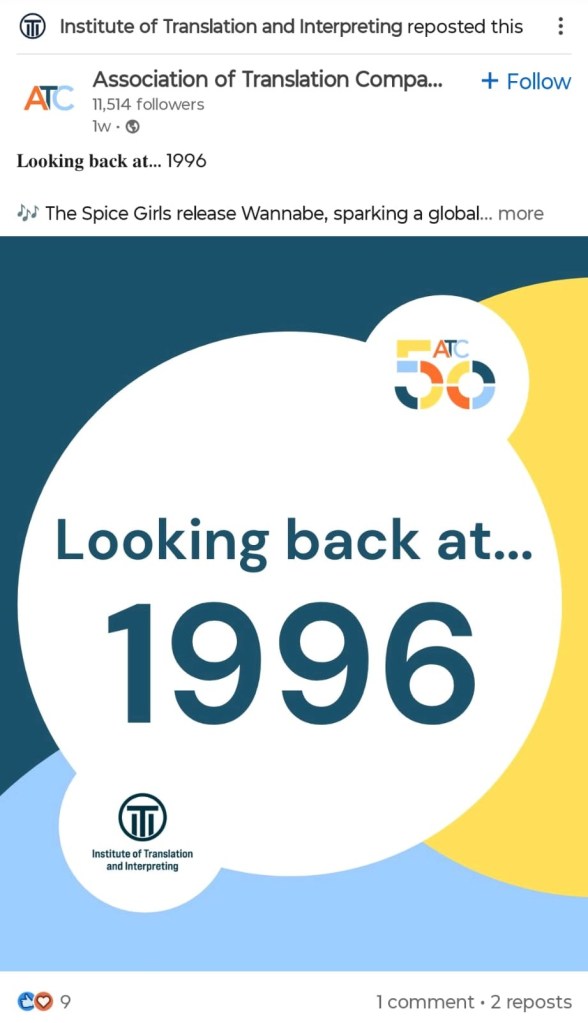
A screenshot of ITI reposting the celebratory ATC’s post with the 2 logos
This question matters because the translation and interpreting professions are facing profound challenges. In recent years, translators and interpreters have increasingly experienced intensifying economic pressures, growing precarity, and rising job insecurity. Numerous academic studies have documented these developments. My own doctoral research similarly found evidence of deteriorating working conditions and documented forms of exploitation experienced by some public service interpreters operating within outsourced systems. These realities are not marginal issues. They are among the defining challenges facing the profession.
Against this backdrop, celebratory narratives about industry success deserve scrutiny. Why is ITI choosing celebration as the dominant narrative while structural problems remain insufficiently acknowledged?
For several years, I have raised concerns with ITI and other UK professional organisations regarding what I perceive as an increasingly corporate-aligned narrative surrounding the profession, especially after the Working Together white paper. I question why the priorities and perspectives of commercial stakeholders are becoming so prominent that they begin to obscure the lived realities of translators and interpreters.
When translators and interpreters face declining rates, growing uncertainty, increasing technological disruption, and weakened bargaining power, representation matters. The stories that institutions tell about the profession matter. The voices that are amplified matter. A professional institute has a fundamentally different purpose from a trade association. It should also have different responsibilities and objectives. It exists to advance professional standards, support practitioners, and advocate for the interests of those who perform the work. Also worth noting is the fact that translators and interpreters constitute a highly racialised and feminised workforce that is facing uncertain future shaped by machine translation and AI.
Questions therefore arise when public communications increasingly emphasise partnership, alignment, and shared celebration, while the tensions within the profession receive comparatively less attention, if any. Who benefits from this alignment? More importantly, who does not?
This has implications for policy, procurement, public understanding, and the labour rights of translators and interpreters. I have previously argued that meaningful change requires educating end clients, commissioners, policymakers, and the wider public about the realities of translation and interpreting work. The economic and professional challenges facing practitioners will not be resolved without honest public discussion. Change requires broader awareness of how translation and interpreting services are commissioned, valued, and evaluated. That is why representation matters so much.
If public-facing narratives emphasise unity, success, and partnership while downplaying questions of precarity, exploitation, and professional vulnerability, there is a risk that the people with the power to influence change never fully appreciate the scale of the problem.
This brings us back to the symbolism of those anniversary celebrations. Do these celebrations inadvertently reinforce a narrative that the interests of commercial organisations and individual practitioners are naturally aligned, even when the evidence suggests the relationship is often far more complex?
In this context, translators and interpreters also have a responsibility to hold their professional institutions accountable. Representation is something that must be actively scrutinised, questioned, and, where necessary, challenged.
At a time when many translators and interpreters are confronting significant economic uncertainty, this is not a trivial question. It is a question about power. It is a question about representation and ethics. And ultimately, it is a question about whose interests are being served when professional and commercial interests align—and celebrate together.
I wonder whether the reasons behind it may be related to epistemic oppression, institutional racism, ethical and strategic failures, conflicting institutional incentives, or organisational arrogance—or some combination of these factors.
About the author
Fardous Bahbouh is a researcher and broadcast interpreter specialising in labour rights and the political economy of the translation and interpreting industry. Alongside her academic research, she continues to work with agencies and production companies that value interpreters and translators and provide fair working conditions. She also runs a small translation company and does not generalise critiques of unfair intermediaries to all translation companies or agencies.
Blog Image
Daniela Zampieri / https://betterimagesofai.org / https://creativecommons.org/licenses/by/4.0/


Leave a Reply