

Last month, my MP, Wes Streeting, wrote to the Government on my behalf after I raised concerns about the working conditions experienced by agency workers, including workers who may technically be free to reject assignments but operate in circumstances where exercising that freedom can have consequences.
I have now received a response from the Department for Business, Innovation, Science and Trade, and I am very grateful to my MP and his team for taking my concerns seriously and raising them with the Government.
There is much in the response that agency workers should know about.
The Department acknowledges that:
“agency work can offer flexibility but can also leave some workers vulnerable.”
More importantly, it recognises something that will be familiar to many people working through agencies:
“workers who are not formally obliged to accept shifts may nevertheless fear what might happen if they decline shifts too often.”
I was particularly pleased to see this recognised so clearly. Having the contractual right to refuse work does not necessarily mean that a worker has meaningful freedom to exercise that right.
The Government also points to the existing legal framework protecting agency workers and to the role of the Fair Work Agency in enforcing the Conduct Regulations against non-compliant agencies.
But perhaps the most encouraging part of the response concerns the Employment Rights Act 2025. The Department says that the Act will:
“tackle one-sided flexibility for agency workers”
by extending protections to qualifying agency workers, including rights relating to guaranteed hours, reasonable notice of shifts, and compensation where shifts are cancelled, rescheduled or cut short at short notice.
Those words matter: “one-sided flexibility.”
For years, flexibility has too often been discussed as though it were automatically beneficial to workers. But there is an important difference between flexibility that gives workers genuine choice and flexibility that allows organisations to transfer uncertainty, waiting time and economic risk onto the people doing the work.
I am sharing the Department’s response in full because I think other agency workers should read it.
And I would strongly encourage interpreters, translators and other agency workers who are experiencing insecurity, short-notice assignments, cancellations, fear of refusing work, lack of transparency or other problems with agency work to write to their MPs. Tell them what is happening. Give them concrete examples. Ask them what protections apply to you and what the Government is doing about them.
In collaboration with the NUPIT – National Union of Professional Interpreters and Translators, I have already prepared a letter template that practitioners can adapt and send to their own MPs. It asks MPs to press the Government for greater transparency about pay and working conditions in publicly funded supply chains and for action to prevent labour exploitation within them.
My experience here shows why doing so can be worthwhile. An MP can take an individual worker’s concerns and put them directly to Government. I am sincerely grateful to Wes Streeting and his team for doing exactly that on my behalf — and to the Department for providing a substantive response.
Cautious optimism
There is, however, an important difference between recognising a problem, legislating for change and changing people’s working lives.
The language in this letter gives me reason for optimism. Recognising “one-sided flexibility” and acknowledging that workers may fear the consequences of declining work are important steps.
But the real test will be implementation.
We need to see how these rights are translated into regulations, which agency workers qualify, how effectively workers are informed of their rights, whether they can exercise them without adverse consequences, and whether enforcement has sufficient reach and resources to make those rights meaningful in practice.
For those of us concerned with precarious agency work, therefore, this is not the end of the conversation. This is not the first time Wes and his team have helped me obtain a substantive government response: they have previously raised my concerns with the Cabinet Office and the Department of Health and Social Care, helping to bring important questions about working conditions in publicly funded services directly to Government.
Indeed, this is a development worth welcoming.
And today, I am happy to welcome it.
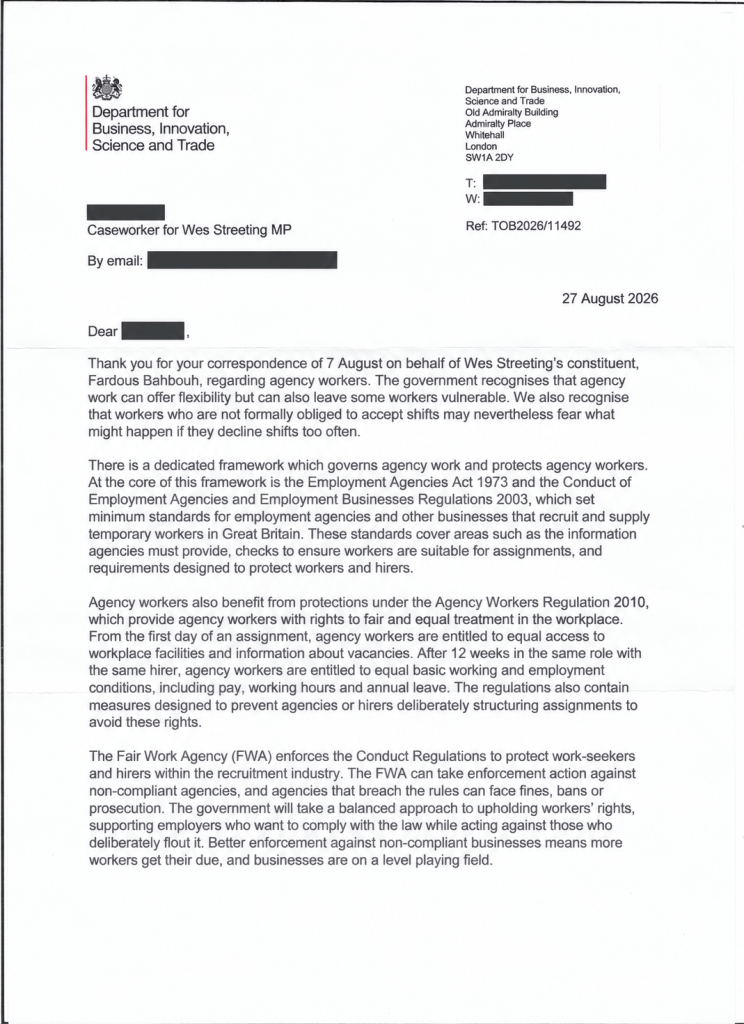
Text of the response:
Dear [name of the Caseworker for Wes Streeting MP]
Thank you for your correspondence of 7 August on behalf of Wes Streeting’s constituent, Fardous Bahbouh, regarding agency workers. The government recognises that agency work can offer flexibility but can also leave some workers vulnerable. We also recognise that workers who are not formally obliged to accept shifts may nevertheless fear what might happen if they decline shifts too often.
There is a dedicated framework which governs agency work and protects agency workers. At the core of this framework is the Employment Agencies Act 1973 and the Conduct of Employment Agencies and Employment Businesses Regulations 2003, which set minimum standards for employment agencies and other businesses that recruit and supply temporary workers in Great Britain. These standards cover areas such as the information agencies must provide, checks to ensure workers are suitable for assignments, and requirements designed to protect workers and hirers.
Agency workers also benefit from protections under the Agency Workers Regulation 2010, which provide agency workers with rights to fair and equal treatment in the workplace. From the first day of an assignment, agency workers are entitled to equal access to workplace facilities and information about vacancies. After 12 weeks in the same role with the same hirer, agency workers are entitled to equal basic working and employment conditions, including pay, working hours and annual leave. The regulations also contain measures designed to prevent agencies or hirers deliberately structuring assignments to avoid these rights.
The Fair Work Agency (FWA) enforces the Conduct Regulations to protect work-seekers and hirers within the recruitment industry. The FWA can take enforcement action against non-compliant agencies, and agencies that breach the rules can face fines, bans or prosecution. The government will take a balanced approach to upholding workers’ rights, supporting employers who want to comply with the law while acting against those who deliberately flout it. Better enforcement against non-compliant businesses means more workers get their due, and businesses are on a level playing field.
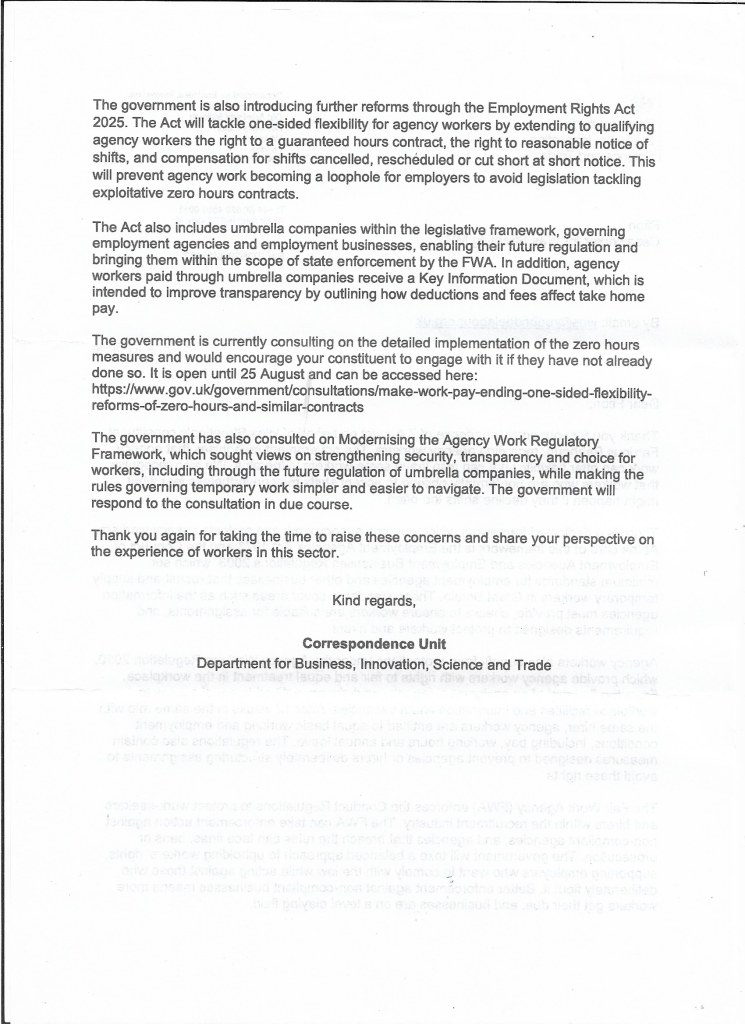
The government is also introducing further reforms through the Employment Rights Act 2025. The Act will tackle one-sided flexibility for agency workers by extending to qualifying agency workers the right to a guaranteed hours contract, the right to reasonable notice of shifts, and compensation for shifts cancelled, rescheduled or cut short at short notice. This will prevent agency work becoming a loophole for employers to avoid legislation tackling exploitative zero hours contracts.
The Act also includes umbrella companies within the legislative framework governing employment agencies and employment businesses, enabling their future regulation and bringing them within the scope of state enforcement by the FWA. In addition, agency workers paid through umbrella companies receive a Key Information Document, which is intended to improve transparency by outlining how deductions and fees affect take home pay.
The government is currently consulting on the detailed implementation of the zero hours measures and would encourage your constituent to engage with it if they have not already done so. It is open until 25 August and can be accessed here:
https://www.gov.uk/government/consultations/make-work-pay-ending-one-sided-flexibility-reforms-of-zero-hours-and-similar-contracts
The government has also consulted on Modernising the Agency Work Regulatory Framework, which sought views on strengthening security, transparency and choice for workers, including through the future regulation of umbrella companies, while making the rules governing temporary work simpler and easier to navigate. The government will respond to the consultation in due course.
Thank you again for taking the time to raise these concerns and share your perspective on the experience of workers in this sector.
Kind regards,
Correspondence Unit
Department for Business, Innovation, Science and Trade
 Lingua Media Connect
Leave a comment