
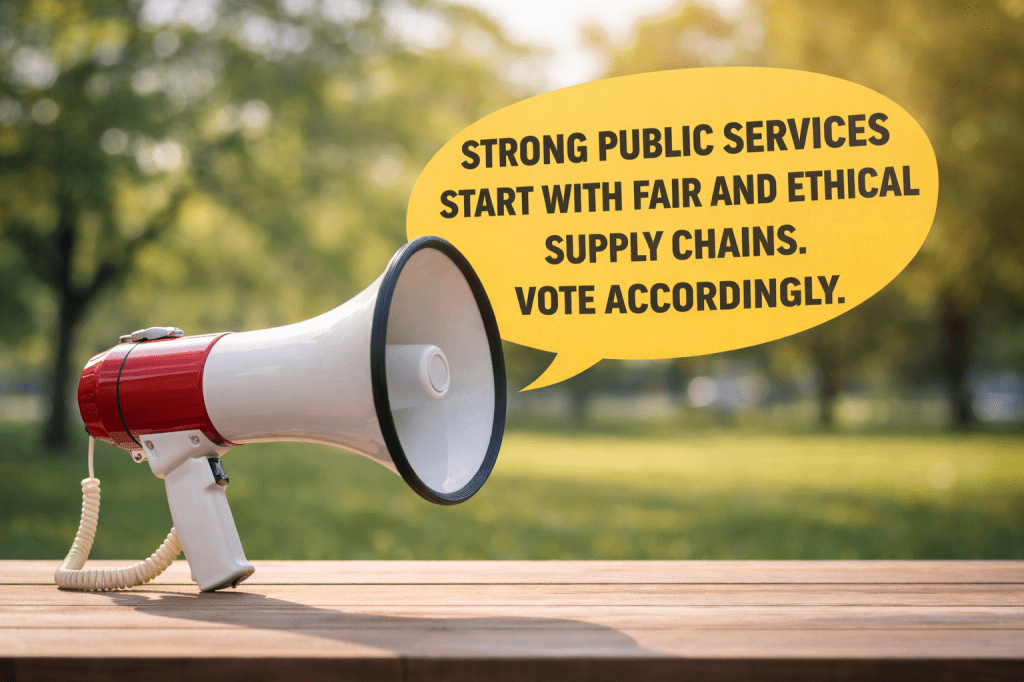
As the UK prepares for the upcoming elections, an issue that deserves far greater public attention is the risk of exploitation within outsourced public service supply chains. Voters in Scotland and Wales will elect representatives to their national parliaments, while a number of local council and mayoral polls will take place in England. Across these elections, candidates should be asked how they intend to monitor working conditions in publicly funded services delivered through external contractors and agencies.
An increasing proportion of public services are delivered through outsourcing arrangements, yet oversight of working conditions within these systems often remains insufficient. If public money is being used, the public has a right to expect that it supports fair, safe, and ethical employment practices.
Today, many professionals working in publicly funded services are no longer directly employed by public bodies but instead operate through agencies or subcontractors. While outsourcing is often justified on the basis of efficiency or flexibility, it can also create distance between public institutions and the realities faced by workers delivering essential services. This distance can allow poor labour standards to persist unnoticed.
For example, my PhD research on inequalities in outsourced public service interpreting highlights serious concerns about inadequate health and safety considerations, as well as very low — sometimes exploitative — rates of pay. Interpreters play a critical role in enabling access to healthcare, legal systems, and social services, yet their working conditions frequently fail to reflect the importance and responsibility of their role. These issues are unlikely to be unique to interpreting alone; similar risks may exist across other outsourced services relied upon by public authorities.
Greater transparency and monitoring are needed to ensure that public funds are not indirectly supporting unfair or harmful employment practices. Procurement decisions should consider not only cost efficiency, but also whether suppliers uphold fair pay, safe working conditions, and ethical treatment of workers. Responsible commissioning is not simply a financial matter — it is a matter of public values.
Before casting your vote, consider speaking with candidates and asking how they intend to monitor labour standards within outsourced services. We should make it clear that voters care about where public money goes and the conditions under which publicly funded work is carried out. I have already spoken with a local councillor and a candidate from another party, encouraging them to treat this issue as a priority. Engagement at the local level can help ensure that these concerns are not overlooked.
Many of us already recognise that fair pay and equality benefit society as a whole. Decent working conditions contribute to stronger communities and can help address some of our most urgent societal challenges, including child poverty, inequality, and social exclusion. When workers are treated fairly, the positive effects extend far beyond individual workplaces.
Elections shape the everyday services that affect our communities. By encouraging candidates to prioritise fair labour practices within public service supply chains, we can help ensure that public money supports not only efficient services, but also ethical and sustainable employment. Ending exploitation within outsourced public services should be part of a broader commitment to fairness, accountability, and social wellbeing.
For more information, you can read my open letter to the Secretary of State for Education and Minister for Women and Equalities, Bridget Phillipson urging the government to publish its action plan to prevent exploitation within public supply chains. You can also read a series of articles summarising key findings from my PhD research. These findings highlight inadequate health and safety considerations, low pay and financial insecurities, challenging working conditions, the implications of technologies that may intensify precarity, and factors that contribute to diminishing bargaining power.
About the author
Fardous Bahbouh is a Researcher and Consultant specializing in Labour Rights, Public Policy, and the Political Economy of the Translation Industry. Her research is funded by Arts and Humanities Research Council (AHRC) / The White Rose College of the Arts and Humanities (WRoCAH).
 Lingua Media Connect
Leave a comment