

In the United Kingdom (UK), public service interpreting (PSI) is a state function mandated by legal frameworks and funded by taxpayers. However, its delivery is predominantly outsourced to private language service providers (LSPs), where interpreters’ labour is subject to market competition and cost-cutting logics. This study examines the inequalities experienced by interpreters in PSI through an integrated framework combining political economy, intersectionality, and theories of justice.
Despite the essential contribution interpreters make to public services such as healthcare, justice, and welfare, their work remains undervalued, insecure, and insufficiently recognised in both policy and academic scholarship. Existing PSI research has largely concentrated on interpreters’ training, duties, standards, and performance evaluation, with limited systematic attention to interpreters’ socio-economic realities or to the structural determinants of inequality.
This is the second blog article presenting findings from my PhD research at the University of Leeds, which examines inequalities in outsourced public service interpreting (PSI) in the UK. The first article discussed health and safety risks, as well as the lack of clear accountability, guidance, and training. While academic research frequently describes PSI as characterised by low pay (Dong & Turner, 2016; Drugan, 2020; Leminen & Hokkanen, 2024; Tipton, 2017), this article explores how low rates of pay are in practice. The results highlight significant levels of financial insecurity across the profession and raise important questions about the sustainability of PSI as a career.
This post summarises key findings related to pay rates, cancellations, financial stability, and interpreters’ perceptions of their earnings.
Key finding: most interpreters receive no employment benefits
As Figure 1 illustrate, among the 54 interpreters who responded:
- 98% do not receive paid sick leave
- 94% do not receive paid holiday leave
- 96% do not receive pension contributions from agencies or public service institutions
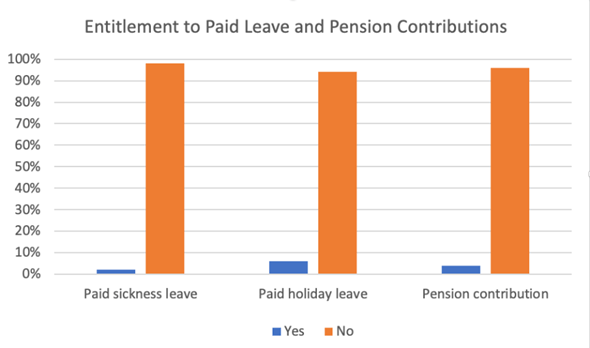
Figure 1: Entitlement to Paid Leave and Pension Contributions Among PSI Interpreters
This means that most interpreters must cover periods of illness, holidays, and retirement savings entirely from their own income.
While many interpreters work on a freelance basis, the central question is whether current rates of pay are sufficient to allow interpreters to cover these costs independently. Many respondents indicated that this is not the case.
Payment uncertainty and unpaid time
A significant number of interpreters reported uncertainty about whether they are paid for the full time they are booked.
For example:
- around half of respondents reported not always being paid for the full booked time when assignments end early
- 35% reported being paid per minute rather than per hour
- 24% said they are never paid for waiting time during remote interpreting assignments
Several respondents described being logged in and available for work for long periods without receiving calls, meaning that substantial portions of their working day are unpaid.
One interpreter reported receiving up to 50 calls per day but earning only £250 for the entire week. Others described being unable to plan their personal lives because they did not know when calls would arrive.
This is a significant finding, as the practice of paying interpreters per minute of work has received little attention in interpreting studies. It reflects Standing’s (2023) analysis of the precarious conditions faced by platform-based workers, who are paid only for the time they are actively engaged in tasks. However, the interpreters’ situation appears to represent an extreme form of precarity: unlike many app-based workers who are typically booked for multi-hour shifts, interpreters’ “shifts” may last only a few minutes at a time.
Per-minute pay and low effective hourly earnings
The survey asked interpreters about the lowest and highest rates they have been offered in order to evaluate the range of pay available in the PSI market. It also asked respondents to report the rates they most commonly accept for assignments paid per minute of interpreting.
The boxplot in Figure 2 illustrates the rates reported by respondents for per-minute assignments. The rates offered range from £0.12 to £0.75. The rates most commonly accepted show a median of £0.31 per-minute. Given the high variation in responses, the median provides a more reliable indicator than the mean, as it represents the middle value in the distribution and is less affected by extreme values.
As Figure 2 shows, the highest rates offered for per-minute interpreting assignments are only marginally above the average rates that interpreters commonly accept, with substantial overlap in the distributions. This narrow spread suggests that the ceiling of per-minute remuneration in PSI is itself low. Consequently, interpreters’ acceptance of these rates appears less a matter of individual preference or negotiation and more a reflection of restricted market conditions. In other words, interpreters are largely working with the rates that are available to them, rather than exercising meaningful choice within a diverse or competitive pricing landscape.
A further surprising aspect of interpreters’ payment is that even per-minute rates are often calculated by the number of seconds interpreters spend on a call, rather than rounding up to full minutes. One interpreter stated: “Many platforms require interpreters to log in but only pay for the interpreting time by the second. This is a clear exploitation enabled by different government departments by accepting such services.” Such a comment reflects interpreters’ sense that public bodies are failing in their duty of care towards workers in their supply chains, raising concerns about how outsourced arrangements permit—and normalise—these unfair practices.
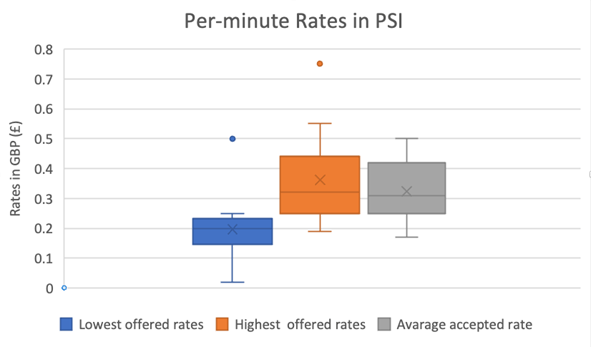
Figure 2: Per-minute Pay Rates in PSI
Figures 3 and 4 illustrate that the rates most commonly accepted show a median of £13 for hourly assignments and £120 for daily assignments.
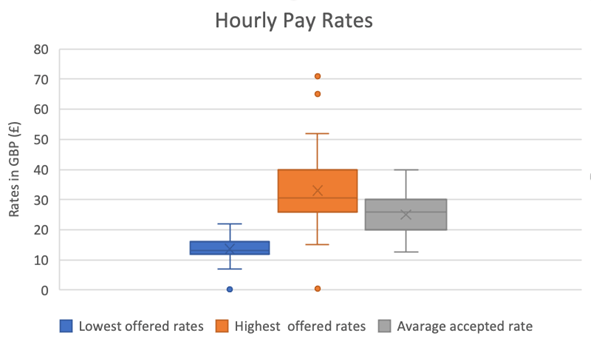
Figure 3: Hourly Pay Rates in PSI
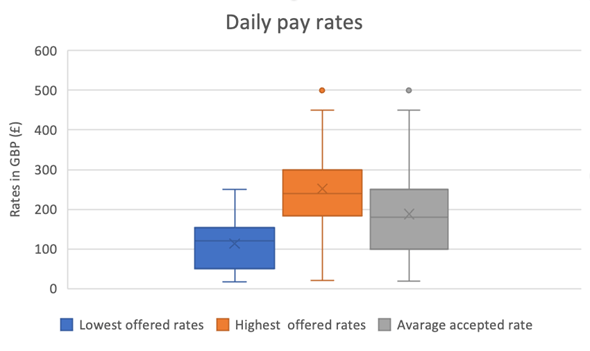
Figure 5: Daily Pay Rates in PSI
Although some hourly rates appear comparable to the UK National Minimum Wage, many interpreters noted that unpaid travel time, waiting time, and preparation time significantly reduce their effective hourly earnings.
For example, one interpreter described travelling two hours each way for a one-hour assignment paying £13.50, resulting in an effective hourly rate of £2.70.
Others described payment structures in which the first hour is paid at one rate, with additional hours paid at a lower rate.
Half of respondents earn less than £10,000 per year from PSI
When asked about their annual income from PSI work:
- 50% reported earning less than £10,000 per year
- only 4% reported earning more than £25,000
- no respondents reported earnings above £35,000
These values are illustrated in Figure 5. For comparison, the median annual salary for full-time employees in the UK was £39,039 in 2025 (Office for National Statistics, 2025).
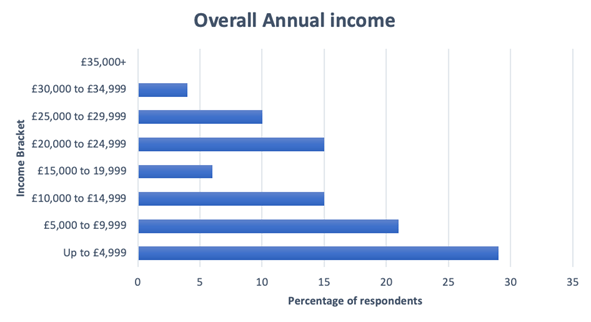
Figure 5: Overall Annual Income from PSI Work
These figures show that all respondents earn substantially less from PSI than the median annual salary for full-time employees in the UK. This finding is particularly significant given the high levels of education and years of professional experience reported by respondents, as discussed in the previous article.
Another useful indicator for contextualising hourly rates is the 2025–2026 Real Living Wage, estimated by the Living Wage Foundation and calculated according to the cost of living, based on a core basket of essential household goods and services (Living Wage Foundation, 2025). The current Real Living Wage is set at £13.45 across the UK and £14.80 in London. Comparing interpreters’ rates to the Real Living Wage suggests that many interpreters earn less than this benchmark. However, it is important to recognise that some interpreters are paid per minute, meaning that this comparison can only provide an estimate, as hourly equivalents do not fully reflect their actual earnings.
A further illustration of the precarity experienced by PSI interpreters can be seen in the multiple ways in which hourly rates are fragmented into smaller segments, each attached to different conditions and levels of pay. One interpreter offered a detailed description of the combined rates on offer for in-person assignments, which pay only for the time spent interpreting rather than the total time booked:
“When [an] agency has a job for 2 or 3 hours, I block the 2 or 3 hours for this job. If the job takes only 1 hour 15 minutes, then I will be paid 1 hour and 15 minutes. This is the main agency. Also, the first hour has a specific rate, and each additional hour is paid less. So, for example, a 3-hour job is paid £13.50 for the first hour, and the other two hours are paid £10 per hour.”
Many interpreters further explained that these low rates are compounded by unfair cancellation policies. If an interpreter cancels an assignment, they may be penalised—for instance, with a £50 cancellation fee if notice is given less than seven days before the booking. This penalty is deducted directly from the interpreter’s wages. Such practices align with existing observations of firms’ increasing ability to tighten contract conditions in order to minimise their own insecurity “through the threats of penalties” (Standing, 2021, p. 43). Interpreters are not only denied paid sick leave or coverage for other emergencies but may also face penalties for lateness or inability to attend assignments. They also exemplify what Standing describes as the “flexibilization” and “dismantling” of the public sector, which was traditionally regarded as a leader in labour standards and secure employment, offering a high level of social income through extensive benefits, structured bureaucratic frameworks, and a strong ethic of public service (2021, p.60). Increasingly, public sector workers are denied the securities once associated with stable employment yet are still expected to perform essential public functions.
Additionally, the reported low rates help explain why many interpreters express feeling treated unfairly, or even a sense of exploitation by the large interpreting agencies holding public contracts. These descriptions what Nancy Folbre (2021, p. 100) describes as “gain-seeking” behaviour, referring to value extraction, which some economists also describe as rent-seeking or a form of rentier capitalism.
Financial vulnerabilities and long-term insecurities
This section builds on the analysis of pay rates and annual incomes and extends the investigation to other factors shaping interpreters’ overall financial security and ability to plan for the future. It provides further insight into how precarity is experienced in daily life, including indicators such as the ability to cover essential needs, dependence on household support, borrowing, and reliance on state benefits.
Interpreters were asked how often the following statement applied to them: “You feel that your earnings from PSI and all your other work are sufficient to meet your financial needs.” Only 17% of respondents reported that this was frequently the case. A further 21% indicated “sometimes,” while a substantial 62% stated that this was infrequent. These findings suggest that most respondents experience persistent financial insecurity, even when combining PSI with other forms of work.
Interpreters reported various coping mechanisms, including frequent reliance on other household members to cover essential expenses. Reliance on loans to meet basic needs was less common but still notable, as was the need to rely on state benefits to meet basic living costs. Although the survey did not provide a specific definition of “essential expenses,” the consistency of these responses indicates that many interpreters perceive their earnings as insufficient and rely on a range of coping strategies to manage ongoing financial insecurity, as illustrated in Figure 7.
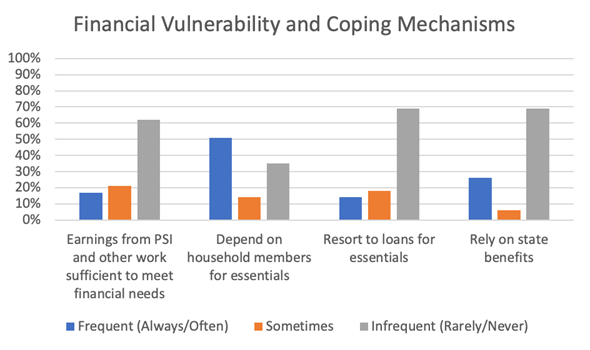
Figure 7: PSI Interpreters’ Financial Vulnerability and Coping Mechanisms
One interpreter described an additional coping mechanism not included in the survey questions, stating: “I have been relying on savings over the last few months.” Another interpreter, who had worked in PSI for 30 years, explained that interpreting is a job they value and perform well, but added: “Interpreting is great but I cannot make enough money from it to make ends meet.”
Across additional indicators of financial security — including ability to save, pension contributions, ability to take time off, and long-term financial confidence — the majority of respondents display patterns of structural insecurity characteristic of precarious labour, as illustrated in Figure 8.
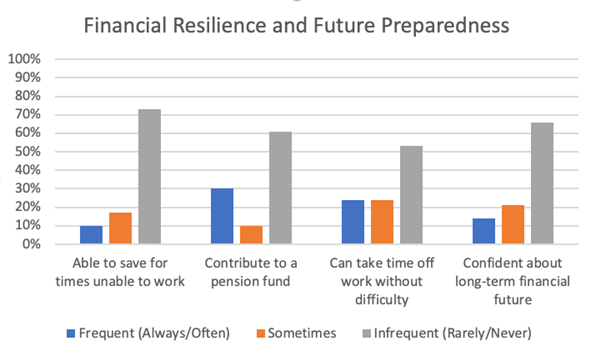
Figure 8: PSI Interpreters’ Financial Resilience and Future Preparedness
These results indicate that many interpreters lack even short-term financial buffers while working in highly insecure arrangements. This finding aligns with Standing’s (2021) account of cumulative economic insecurity and with Folbre’s (2021) analysis of how care-related and feminised labour often incurs long-term financial penalties that may only become visible later in life.
Taken together, these findings demonstrate how precarity manifests not only in daily earnings but across the full spectrum of interpreters’ financial lives. The limited capacity to save, contribute to pensions, take time off, or plan for the long term illustrates how financial risk is systematically shifted onto interpreters, reinforcing dependence on household support, loans, or state benefits.
Dissatisfaction with earnings is widespread
Responses in this section reflect widespread dissatisfaction with earnings and a shared perception among interpreters that their income levels fall below what would be expected for comparable qualifications and experience in other sectors. Overall, 25% of respondents describe themselves as very low earners and 30% as low earners, while a further 23% see themselves as “low-to-average.” Only 6% consider themselves “average-to-high” earners, and none identify as “high” or “very high.” This distribution, represented in Figure 9, highlights a profession characterised by persistently low-income levels.
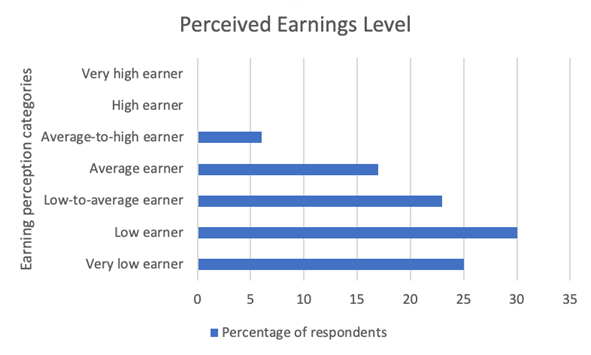
Figure 9: Respondents’ Self-Perception of Earning levels
Perceptions of pay equity relative to other industries are equally revealing. An overwhelming 96% of respondents believe they would earn more in another sector requiring either the same level of education or the same amount of professional experience; none believe they would earn less. This near-unanimous result suggests a strong perception of undervaluation and occupational inequality, reinforcing the view that PSI work is systematically underpaid compared with other professions requiring similar levels of skill and responsibility.
Differences between sectors
The survey also suggests variation in pay across public sector settings.
Assignments for courts and police were reported to pay more than assignments for the NHS or local authorities. This raises important questions about how different public institutions value communication with people who have limited English proficiency.
Moreover, several interpreters indicated that they no longer accept NHS assignments because these tend to offer lower rates than other PSI work. One respondent stated: “I don’t accept assignments for the NHS and local authorities.” This statement, together with similar comments from other respondents, reflects Li’s (2025) findings of an exodus of PSI interpreters from healthcare interpreting due to low pay and challenging working conditions.
An example that captures financial insecurity in outsourced PSI arrangements
“My work has become extremely insecure since the outsourcing of police and court work. I am signed up with various agencies that use online portals and automated emails sent to an unknown number of interpreters. I accept jobs only to hear nothing back in close to 98% of cases. This keeps me constantly tethered to my phone. Some emails use wording such as ‘first come, first served’, which creates a sense of urgency and anxiety. Such automated systems appear blind to my experience, expertise, and reliability, and I feel that these count for very little nowadays. I feel that my job has become part of the gig economy.
For example, Agency A (name anonymised) offers one-hour assignments assisting with PACE interviews in fraud investigations for £13.50 per hour, often located many miles away, with no payment for travel time or expenses, and cancellation fees of £6.75 if the job is cancelled within one hour. This is totally unsustainable. While there is a significant amount of work available — I know this as I also work as a court interpreter assessor — I am struggling to make a living. I am seriously considering leaving the profession.”
— Survey respondent, PSI survey (2025)
Next steps in the research
Further posts will explore:
- how interpreters evaluate their working conditions
- the impact of technological developments on PSI
- interpreters’ ability to negotiate pay and working conditions
- credentialism, regulation and quality control
- moral and institutional precarity in public service delivery
- commitment, meaning, and the paradox of staying
- PSI as a lens on neoliberal labour governance
About the author
Fardous Bahbouh is a Researcher and Consultant specializing in Labour Rights, Public Policy, and the Political Economy of the Translation Industry. Her research is funded by Arts and Humanities Research Council (AHRC) / The White Rose College of the Arts and Humanities (WRoCAH).
 Lingua Media Connect
Leave a comment