

Interpreters play a critical role in ensuring access to justice, healthcare, and social services. This article summarises selected findings from my PhD research at the University of Leeds, which examines inequalities in outsourced public service interpreting (PSI) in the UK.
The survey data suggest a structurally precarious and exploited profession, characterised by the absence of labour rights, inadequate attention to health and safety, and unstable income. Although exploitation was not directly included as a survey category, it emerged strongly and repeatedly in respondents’ written comments, indicating that many interpreters experience their working conditions as fundamentally unfair. Despite high levels of education and the essential role PSI interpreters play in public services, they are underpaid, facing extensive financial pressure, and are exposed to significant occupational risks. Large interpreting agencies holding public contracts exercise disproportionate power over rates, assignments allocation, and contractual terms, creating systemic conditions in which exploitation is normalised. Day-to-day experiences further highlight emotional strain, exhaustion, and workload pressures. Financial, psychological, and operational stress coexist with the intellectual and social rewards of interpreting, illustrating the complex, multidimensional reality of precarity and exploitation in PSI.
Additionally, technological developments, including booking apps and algorithmic assignment allocation systems, introduce further layers of precarity. These apps operate according to opaque rules, allocate work instantaneously on a non-negotiable “take-it-or-leave-it” basis, and embed forms of algorithmic oversight that are perceived to shape future access to assignments. Concerns about AI replacing human interpreters — even when the technology is unreliable — introduce further uncertainty, intensifying both daily instability and long-term professional risk. Structural and individual constraints further shape interpreters’ negotiating power. Dependence on agencies, geographic location, care responsibilities, and internal workforce dynamics limit interpreters’ ability to influence pay or working conditions, reinforcing systemic vulnerability.
While these research findings highlight the erosion of basic rights, this article begins with health and safety, prioritising interpreters’ immediate wellbeing, before presenting findings related to financial insecurity, perceptions of pay, and broader working conditions in subsequent articles. This approach highlights how structural mechanisms of market logic translate into lived experiences of exploitation, risk, and instability.
The focus of this article is on findings that reveal many interpreters face significant health and safety risks, often without adequate institutional protection. Despite UK government guidance stating that self-employed workers are entitled to health and safety protection, the reality for many interpreters suggests a persistent gap between policy and practice.
About the survey respondents
The study included a survey of 54 interpreters based in England (87%), Wales (9%), and Scotland (6%). The relatively small sample size and its uneven geographical distribution may limit the generalisability of the findings to all PSI interpreters in the UK. Nonetheless, as this is an equality-focused study aimed at identifying patterns of inequality, the data remain significant in highlighting systemic problems.
Survey respondents also reported high levels of education and professional qualifications, reflecting the substantial human capital investment made by PSI interpreters. Overall, 24% held an undergraduate degree, 61% a Master’s degree, and 6% a PhD, as well as various professional qualifications. These qualifications stand in sharp contrast to the low rates of pay.
The interpreters who responded to the survey also represented a wide range of professional experience. Seventeen per cent had worked in PSI for one to three years, 13% for four to six years, and almost half (48%) for seven to twenty years. A further 23% had more than twenty-one years of experience, with some reporting careers spanning over three decades. Figure 1 illustrates the distribution of interpreters according to years of experience in PSI. This variation provides an important temporal dimension, offering insights from those who entered the profession before the large-scale outsourcing of PSI services as well as those who joined afterwards.
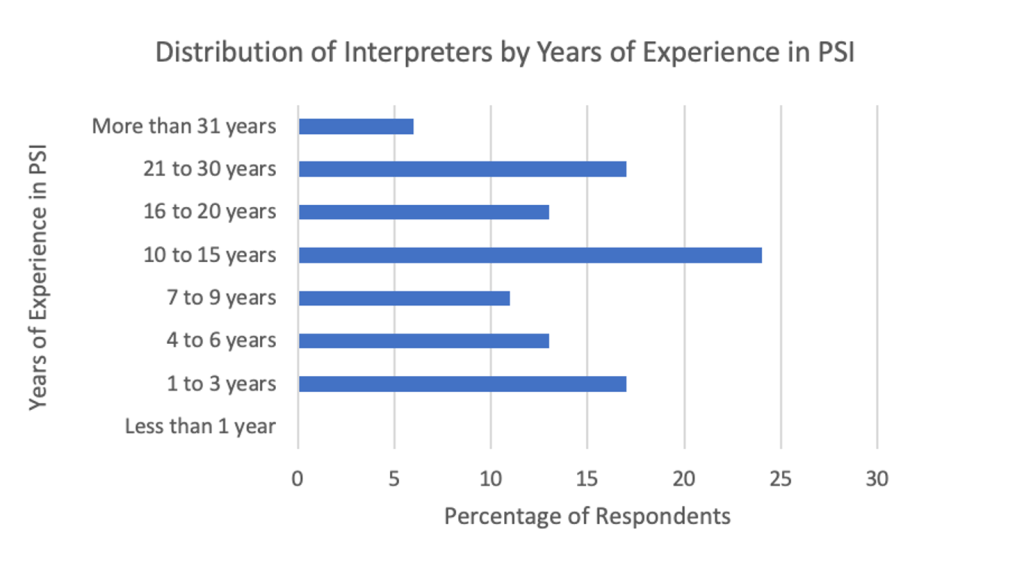
Figure 1: Distribution of interpreters’ years of experience
Physical safety risks in everyday assignments
Survey responses indicate that interpreters are frequently exposed to potentially unsafe environments. Nearly half of respondents reported regularly working in locations that may pose risks, such as private homes or unfamiliar settings. Others described being required to work with individuals who may present unpredictable behaviour or being left alone with detainees without appropriate supervision of a police officer.
Visibility also emerged as a concern. Around 40% of interpreters reported being required to wear name badges displaying their full names in sensitive contexts. In smaller diaspora communities, this may increase the risk of identification and potential repercussions beyond the workplace.
Health-related risks are also common. Over two-thirds of respondents reported working in potentially infectious environments such as hospitals, often without being informed in advance of possible exposure to contagious illnesses. Several interpreters described situations in which they were expected to continue face-to-face work during the COVID-19 pandemic without access to paid sick leave or financial protection if illness prevented them from working.
These findings suggest that interpreters are routinely placed in situations where risk information is incomplete, communication is insufficient, and protective measures are inconsistent, as illustrated in Figure 2.
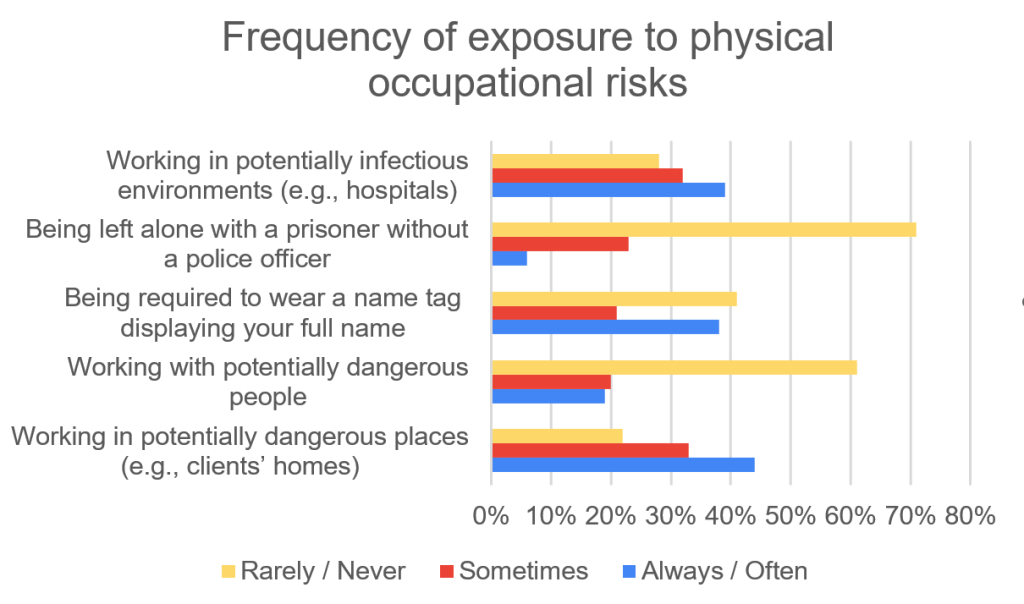
Figure 2: Frequency of exposure to physical occupational risks among PSI interpreters
These occupational risks were further illustrated in interpreters’ responses to the open-ended question. Respondent reported not receiving clear guidance when book for assignments that involved working with clients affected by contagious illnesses such as tuberculosis, scabies, and various neurological or psychological conditions. One court interpreter stated that they had to stand in the dock beside an individual with a highly contagious disease without being informed about their condition. Another interpreter listed a several serious health and safety situations including booking involved being left with a detainee in the same room without security, and being spat at and sworn at during attending assignments at a mental institution. Another interpreter described the difficulty of communicating safety concerns to the agency that had booked them for an assignment in which they were left alone with an angry client.
One interpreter noted that “the COVID pandemic is a good example of the lack of support for interpreters,” adding that they were required “to continue working under difficult circumstances and, more often than not, face to face.” Due to their self-employed status, interpreters are excluded from paid sickness leave and most pandemic-related financial support. Although PSI interpreters were classified as key or frontline workers, many were not offered financial support or paid sick leave when unable to work due to illness or self-isolation, raising serious ethical concerns of expecting interpreters work in contagious places without even being offered compensation for the time they can’t work if they catch a virus.
Emotional strain and psychological pressures
In addition to physical risks, interpreters reported high levels of psychological strain. Over 40% of respondents stated that they frequently encounter emotionally distressing situations, reflecting the nature of interpreting work across healthcare, legal, and social service settings, where traumatic narratives and crisis situations are common.
More than half of respondents reported working long periods without adequate breaks, compounding fatigue and emotional stress. Many highlighted the absence of formal mechanisms for debriefing or psychological support following difficult assignments.
Financial insecurity further intensifies stress levels. Unpredictable workloads, last-minute cancellations, and the need to remain constantly available for potential bookings create ongoing anxiety. Some interpreters described feeling compelled to accept stressful assignments or remain on call for extended periods due to fear that work opportunities might disappear.
Several respondents indicated that these pressures have led them to consider leaving the profession or shifting to remote interpreting roles in order to reduce exposure to risk.
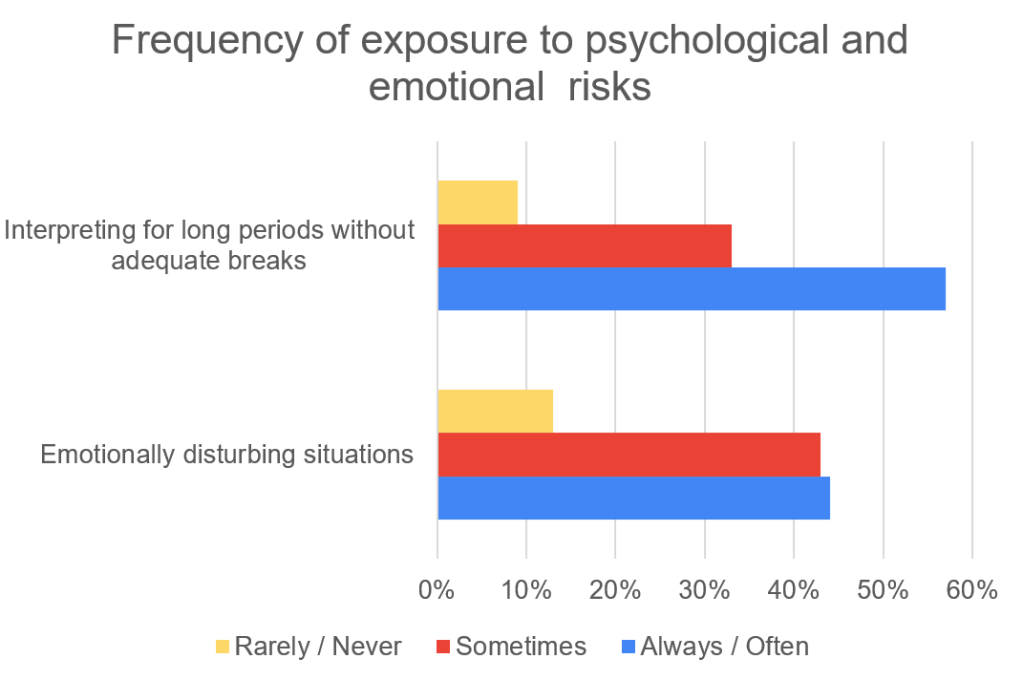
Figure 3: Frequency of exposure to psychological occupational risks among PSI interpreters
Interpreters’ responses highlighted the emotional strain inherent in public service interpreting and the lack of psychological support. One interpreter remarked: “Interpreting is a lonely job—no one to debrief with after emotionally draining sessions.” In addition to the stressful situation interpreters work in, the stress from financial insecurity could further impact their mental health and well-being. One interpreter explained that:
“After 8 years, I am considering quitting interpreting due to work instability and unpredictability. I can no longer deal mentally with the lack of certainty of income each month despite attempting to combine with other part-time work. Last-minute cancellations compound the problem where there are no full booking time-assured payments. I can no longer manage the requirement for availability during the booking process (having the phone on ring and being able to respond quickly and negotiate travel and additionals. My mental health has now overtaken any previous considerations of all the time, money and energy invested into this high-maintenance profession.”
Many of the interpreters’ statements reflect the profound emotional toll characteristic of long-term precarity. For example, one interpreter stated, “It is a crap choice of a career and I strongly feel to have wasted the 15 years I dedicated to it.” This suggests deep frustration and even a tendency to question their decisions, life achievements, and future prospects. Moreover, searching for work outside PSI adds further strain on interpreters’ health and wellbeing. One interpreter described this pressure as “mentally and emotionally draining and exhausting.”
Lack of training and blurred responsibility
The survey also revealed a lack of systematic health and safety training. More than half of respondents reported that they had not been offered any formal training by agencies or institutions. While some interpreters recalled isolated sessions, such as NHS training on managing physical aggression, these examples were exceptions rather than standard practice.
A key issue underlying these gaps is the diffusion of responsibility between public bodies and contracted interpreting agencies. As interpreting services are increasingly outsourced, accountability for interpreters’ wellbeing becomes fragmented. Public institutions rely on private agencies to manage recruitment and working conditions, while agencies often position interpreters as independent contractors responsible for managing their own risk.
As a result, responsibility for providing safety information, training, and psychological support can fall between organisational boundaries. Interpreters frequently report difficulty obtaining basic information about assignments, including potential risks, location conditions, or the expected duration of emotionally demanding sessions. This lack of transparency leaves interpreters unable to make fully informed decisions about accepting work and undermines their ability to protect themselves.
The outsourcing model can therefore obscure who is responsible for safeguarding interpreters’ welfare. Although interpreters work within public service settings alongside professionals who benefit from structured health and safety frameworks, interpreters themselves often remain outside these systems. This creates a situation in which interpreters are essential to service delivery but peripheral in terms of institutional protection.
A structural gap in protection
Taken together, the findings suggest that health and safety risks in public service interpreting are not isolated incidents but reflect broader structural challenges linked to outsourcing and the widespread use of self-employed contracts. Interpreters occupy a paradoxical position: they are essential to the functioning of public services, yet frequently excluded from the protections afforded to other professionals working alongside them.
Addressing these concerns requires clearer allocation of responsibility between public bodies and interpreting agencies, improved transparency about assignment risks, access to training and psychological support, and greater recognition of interpreters as integral contributors to public service delivery.
Improving health and safety protections is not only a matter of worker welfare, but also of ensuring the sustainability and quality of interpreting services that underpin equitable access to public institutions.
About the author
Fardous Bahbouh is a Researcher and Consultant specializing in Labour Rights, Public Policy, and the Political Economy of the Translation Industry. Her research is funded by Arts and Humanities Research Council (AHRC) / The White Rose College of the Arts and Humanities (WRoCAH).
 Lingua Media Connect
Leave a comment