
By Fardous Bahbouh, Researcher & Consultant on Labour Rights, Public Policy, and the Political Economy of the Translation Industry
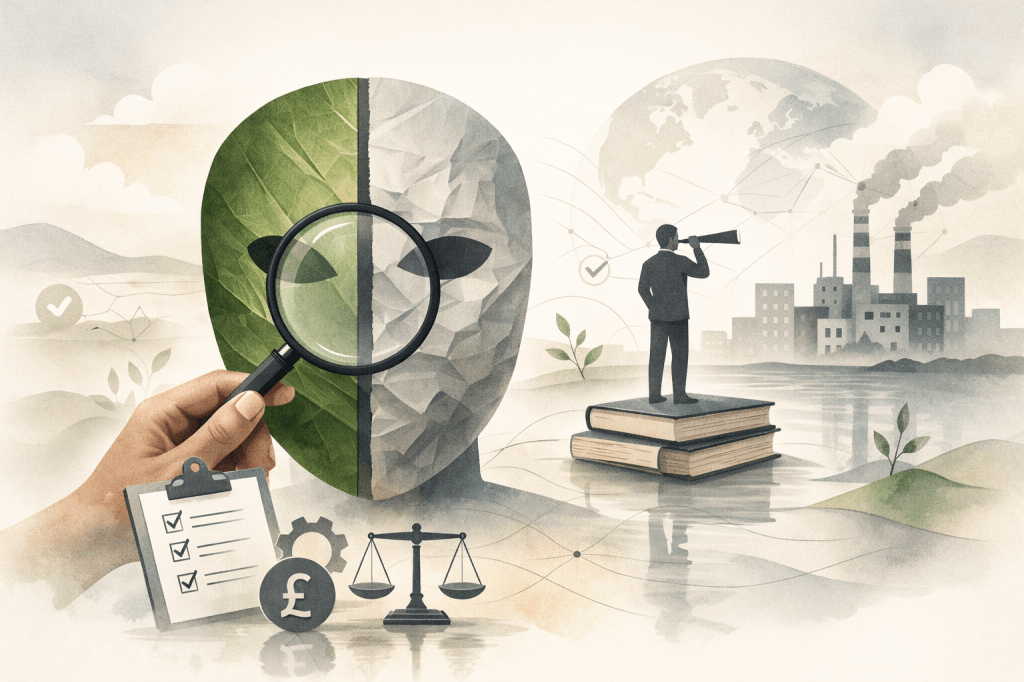
Greenwashing is a well-established concept in environmental and corporate debates. It describes situations in which companies market themselves as ethically or environmentally responsible while their actual practices fall short. Classic examples include Volkswagen’s “clean diesel” scandal (BBC, 2015), BP’s “Beyond Petroleum” rebranding (Financial Times, 2019), and Coca-Cola’s “World Without Waste” campaigns (Greenpeace, 2019). These cases have provided consumers and the public with a toolkit to identify inconsistencies between claims and real-world actions.
In the translation industry, however, no equivalent regulatory frameworks or standardized principles exist to monitor ethical claims. As a researcher, I cannot cite specific companies, but the lack of formal oversight creates space for what I call “ethical-washing” — marketing or portraying ethical responsibility without sufficient accountability. The same governance principles that regulators apply to environmental claims are increasingly central to responsible supply chain oversight and Environmental, Social, and Governance (ESG) reporting.
My aim here is not to accuse, but to provide readers with conceptual tools so they can identify such situations themselves and make informed judgments when they encounter ethical claims in professional contexts.
What Can Greenwashing Teach Us?
Over the past two decades, researchers and regulators have identified recurring patterns in greenwashing. Environmental watchdogs describe it not as a single act of deception, but as a set of recognizable signals. These include vague or undefined claims (“eco-friendly” without evidence), selective disclosure (highlighting one positive feature while ignoring wider harms), lack of independent verification, exaggerated impact, hidden trade-offs, and self-created labels that imply oversight where none exists.
At its core, greenwashing relies on a gap between moral language and measurable practice. The language signals responsibility; the underlying structures may not support it.
These principles can be adapted beyond environmental marketing. In industries without strong regulatory oversight — including the translation and interpreting sector — similar dynamics can emerge. When agencies describe themselves as “ethical,” “empowering,” or “community-oriented,” the same questions used to detect greenwashing become relevant:
- Are the claims clearly defined and measurable?
- Is there transparent information about pay structures and accountability?
- Are trade-offs openly acknowledged, or are only positive aspects highlighted?
- Is there independent verification, or only internal declarations?
- Do outcomes match the moral narrative?
In academic writing about the translation industry, these principles also apply. When scholarship celebrates collaboration, innovation, or impact, readers can ask: What evidence supports these claims? Who benefits? Who bears risk? Are labour conditions examined alongside institutional narratives?
Transparency about conflicts of interest and disciplinary boundaries is equally important, particularly in interdisciplinary spaces. The aim is not to undermine collaboration, but to cultivate ethical literacy. Just as consumers have learned to question environmental marketing, translators, scholars, and clients can learn to evaluate ethical claims more critically. Where formal regulatory mechanisms are limited, informed scrutiny becomes an essential safeguard.
Ethical-washing becomes even more convincing — and more problematic — when coupled with epistemic trespassing.
Epistemic Trespassing: When Authority Exceeds Expertise
The concept of epistemic trespassing was coined by philosopher Nathan Ballantyne, who defines it as occurring when “experts make judgments in fields outside their own expertise.” Interdisciplinary work is often productive, but problems arise when someone speaks with the authority of expertise in an area where they lack sufficient methodological grounding, yet their audience assumes credibility because of their status elsewhere. Ballantyne emphasizes that expertise is domain-specific: being an expert in one field does not automatically confer authority in another. When experts overstep their domain without adequate knowledge, they may mislead audiences, distort debates, or unintentionally crowd out more qualified voices. For a concise, accessible overview, philosopher Jonny Thomson provides a short video explanation:
In the translation industry, epistemic trespassing can have tangible consequences. For example, one scholar specializing in translation ethics may focus on translators’ professional responsibilities while writing about labour economics, procurement systems, or market regulation. Similarly, another scholar focusing on translators’ wellbeing may extend their analysis to the translation industry broadly but continue to emphasize individual responsibility for wellbeing. In both cases, structural labour conditions and corporate obligations risk being obscured, even when intentions are ethical and well-meaning.
These examples highlight the importance of epistemic humility. Interdisciplinary work benefits from clear acknowledgment of one’s domain, transparency about limits of expertise, and engagement with specialists across relevant fields. Such practices strengthen both scholarship and professional practice.
While translators undeniably hold professional duties — including accuracy, confidentiality, and avoidance of harm — an exclusive focus on individual responsibility can obscure broader structural obligations. Within contemporary governance frameworks — particularly ESG standards — corporations carry clear responsibilities regarding fair remuneration, reasonable working conditions, and transparent supply chain practices. When ethical discourse concentrates primarily on the moral conduct of individual translators, it risks diverting attention from institutional accountability. Ethical responsibility operates at multiple levels, and overemphasizing one level should not eclipse the others.
Authority shapes policy and professional norms. When ethical discourse is dominated by voices operating outside their epistemic domain, analyses can be incomplete, even if well-intentioned. Combined with ethical-washing, epistemic trespassing can amplify moral language while leaving structural accountability unexamined.
The solution is not disciplinary gatekeeping, but epistemic humility: clear acknowledgment of one’s domain, transparency about the limits of expertise, and collaboration with specialists across relevant fields. These practices strengthen both scholarship and professional practice, ensuring that ethical discourse remains robust, balanced, and actionable.
Conclusion
By drawing from greenwashing principles and ethical scholarship, translators, clients, and consumers can become more attuned to inconsistencies in ethical claims. This awareness strengthens professional integrity and helps safeguard the rights of translators, clients, and the communities they serve. Ethical vigilance — grounded in professional responsibility, structural accountability, transparency, and epistemic humility — remains the best defense against both ethical-washing and epistemic trespassing in the translation industry.
Bibliography
Ballantyne, N. (2019). Epistemic Trespassing. Mind, 128(510), 367–395.
https://doi.org/10.1093/mind/fzx042
BBC. 2015. Volkswagen: The scandal explained. Accessed 25.02.2006. Volkswagen: The scandal explained – BBC News
Financial Times. 2019. BP faces ‘greenwashing’ complaint over advertising campaign. Accessed 25.02.2026. BP faces ‘greenwashing’ complaint over advertising campaign
Greenpeach. 2019. We’re going after Nestlé. Here’s why. Accessed 25.02.2026. We’re going after Nestlé. Here’s why – Greenpeace International
 Lingua Media Connect
Leave a comment