
By Fardous Bahbouh, Researcher & Consultant on Labour Rights, Public Policy, and the Political Economy of the Translation Industry
Introduction:
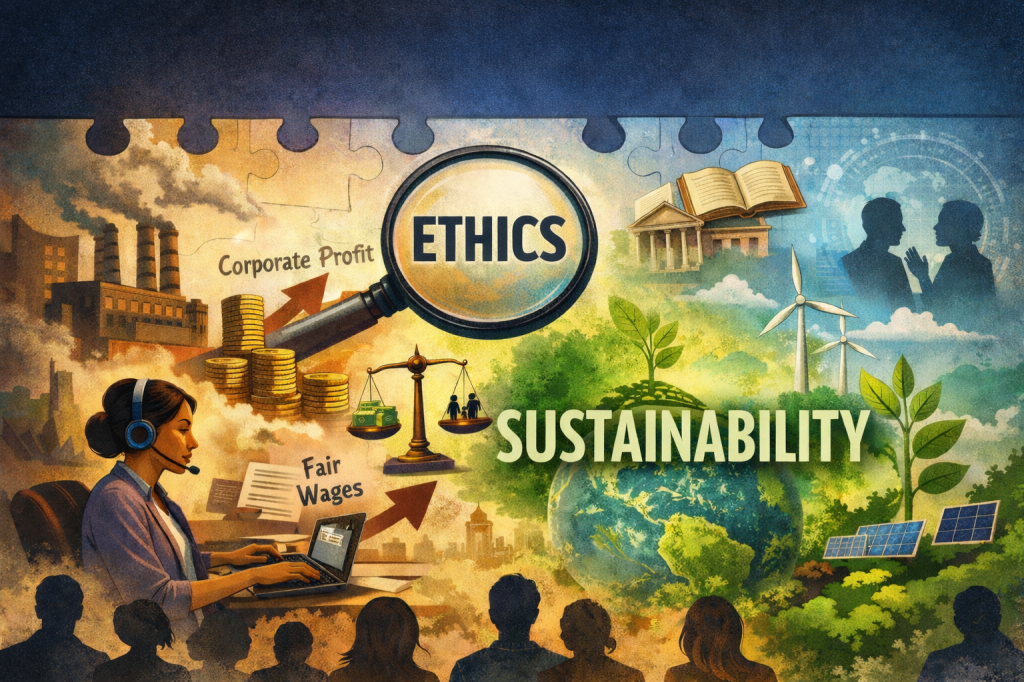
Sustainability has become a widely endorsed and positively charged concept across translation industry studies, professional discourse, and policy debates. Yet closer examination reveals a paradox: while sustainability is frequently invoked, it is often operationalised through three constructed—and potentially misleading—frameworks: translator pipeline sustainability, which prioritises securing a continuous supply of linguists willing to remain in structurally precarious working conditions; individual responsibility sustainability, which shifts the burden of maintaining career viability onto translators and interpreters while leaving corporate accountability insufficiently scrutinised; and environmental-only sustainability, which focuses predominantly on ecological objectives while marginalising labour rights concerns.
The three constructed frameworks are examined in detail in my previous analysis of discourse in academic texts on the translation industry, entitled, On the Ethical Risks of Translation Academics “Collaborating” with the Industry Without Adequate Critical Engagement and Objective Analysis, which establishes the evidential basis for identifying dominant sustainability narratives within the sector and provides a more comprehensive, fully referenced analysis grounded in a political economy framework. This brief article aims to clarify and challenge these misconceptions.
These problems with these constructed frameworks can be illustrated through the well-established analytical lens of Environmental, Social, and Governance (ESG) scholarship, which has increasingly emerged as a global framework for evaluating organisational responsibility and long-term sustainability. ESG emphasises that sustainable organisational performance requires balanced integration of environmental stewardship, social responsibility—including labour standards and workforce wellbeing—and governance structures ensuring ethical and accountable decision-making (Friede, Busch and Bassen, 2015; Eccles, Ioannou and Serafeim, 2014). When applied to labour-intensive professional sectors such as translation and interpreting, ESG highlights that sustainability cannot be reduced to environmental commitments or workforce availability alone but must encompass fair labour conditions and responsible institutional governance.
The foundational definition of sustainability established in the United Nations Brundtland Report Our Common Future defines sustainable development as “development that meets the needs of the present without compromising the ability of future generations to meet their own needs” (United Nations, 1987). Applied to translation and interpreting, this definition implies that industry sustainability must include the capacity of professionals to secure dignified livelihoods, maintain wellbeing, and sustain long-term professional participation. Industry models that depend on unstable income, limited labour protections, or high professional attrition therefore raise fundamental questions about whether sustainability is being realised in practice or invoked rhetorically.
Within ESG scholarship, imbalanced sustainability strategies frequently emerge when organisations prioritise one pillar—most commonly environmental performance or reputational governance indicators—while neglecting social responsibility, particularly labour conditions (Crane et al., 2022). In the translation industry, sustainability discourse can similarly function as a reputational resource for industry actors. Sustainability narratives can generate professional legitimacy and organisational credibility, which may then be leveraged to secure outsourcing contracts or institutional partnerships. However, such narratives risk masking structural labour inequalities and perpetuating the very employment conditions that undermine workforce sustainability. These constructed frameworks therefore risk obscuring whose sustainability is being prioritised and at what cost. Addressing this blind spot requires foregrounding the ethical imperative of sustaining dignified and secure livelihoods, particularly within a workforce that is frequently racialised, feminised, and subject to structural barriers to more stable employment.
Reconceptualising sustainability in translation studies therefore demands a multidimensional analytical framework that integrates labour justice, economic accountability, and institutional responsibility alongside environmental and technological considerations. This article identifies critical gaps within existing sustainability narratives and demonstrates how each framework reflects a partial and uneven application of ESG principles. When insufficiently interrogated, these lenses risk reinforcing sustainability discourses that enhance industry legitimacy and reputational capital without addressing the systemic conditions that undermine workforce sustainability.
1. Translator Pipeline Sustainability: ESG Social and Governance Displacement
The first lens concerns a constructed concept of sustainability in the translation industry that focuses on securing a continuous supply of linguists who will remain in the industry despite predominantly low pay and substandard working conditions. Industry reports frequently highlight attrition among translators and interpreters, framing it as a recruitment and retention challenge. However, evidence suggests that many professionals struggle to secure decently paid work, indicating that the sector’s challenge is not a shortage of skilled labour but a shortage of professionals willing to accept low pay and precarious conditions.
From an ESG perspective, this narrative reflects a displacement of social responsibility. The social pillar of ESG emphasises fair labour practices, equitable remuneration, and workforce wellbeing as central indicators of sustainable organisational conduct (Eccles et al., 2014). When sustainability is framed primarily as workforce supply management, responsibility shifts from organisational labour practices to labour market dynamics. Governance responsibility is similarly obscured, as corporate pricing models, procurement strategies, and profit distribution structures remain insufficiently scrutinised.
For example, the ATC and Nimdzi (2021) report self-reported gross margins of up to 77% in some translation companies, suggesting that fairer remuneration could improve retention without relying on professionals remaining in exploitative roles. Framing attrition as a supply issue therefore allows industry actors to present workforce sustainability as a technical or logistical challenge rather than an ethical labour issue—an interpretation that may strengthen reputational positioning while leaving underlying labour inequalities intact.
2. Individual Responsibility Sustainability: ESG Social Individualisation
A second strand focuses on the economic and professional sustainability of translators and interpreters. Many accounts acknowledge irregular income streams and declining job quality, yet some academic authors who describe themselves specialising in sustainability often frame it in terms as an individual responsibility, emphasising resilience, adaptability, or entrepreneurial self-management.
Within ESG scholarship, this reflects a process of social individualisation, whereby organisational responsibility for labour standards is displaced onto workers themselves (Crane et al., 2019). The ESG social pillar requires organisations to ensure fair employment conditions, career sustainability, and worker protection. However, narratives centred on professional resilience risk normalising structural insecurity by relocating responsibility from corporate actors to professionals.
Moreover, individual adaptability narratives can contribute to reputational discourses portraying the industry as empowering flexible and innovative professionals, while obscuring structural constraints that limit genuine economic stability. In this sense, discourses of professional resilience may unintentionally legitimise precarious labour arrangements by presenting them as opportunities for individual growth rather than symptoms of systemic imbalance, as well as obscuring the responsibilities of corporations towards their workforce.
3. Environmental-Only Sustainability: ESG Pillar Imbalance
A third, increasingly prominent perspective emphasises environmental sustainability, reflecting commitments to reducing ecological harm and intergenerational responsibility. Environmental objectives are essential, particularly given the sector’s integration into global supply chains and digital infrastructures.
However, ESG scholarship consistently warns against pillar imbalance, whereby environmental commitments overshadow social and governance responsibilities (Friede et al., 2015). In the translation industry, foregrounding the narrative around environmental sustainability functions, even if unintentionally, to distract attention to workforce livelihoods risks prioritising long-term planetary wellbeing over the immediate material conditions of the current workforce.
Environmental sustainability narratives can also enhance industry reputational capital by aligning translation companies with broader corporate social responsibility agendas. This alignment may inadvertently divert scrutiny away from labour practices that remain structurally unsustainable. ESG theory emphasises that environmental performance cannot be ethically or strategically sustainable if achieved through labour precarity or governance opacity.
Discussion and Ethical Implications:
Taken together, these perspectives reveal both the breadth of sustainability discourse and a significant analytical gap: insufficient attention to the responsibilities of translation companies and institutional clients. Sustainability is often framed as an outcome achieved by workers or as a system-level concern detached from corporate practices. Far less examined are procurement models, outsourcing arrangements, and pricing structures that shape the viability of professional livelihoods. This analytical gap enables sustainability narratives to function as legitimacy-building mechanisms that enhance industry reputation while leaving labour inequalities structurally embedded.
This gap is heightened by the increasing reliance on platform-based labour, downward rate pressure, and fragmented employment structures. Without addressing these structural dimensions, sustainability risks being reduced to a rhetorical tool for industry reputational gain rather than an ethical framework. Such reputational capital can be leveraged by industry actors to lobby government institutions for additional outsourcing contracts, potentially perpetuating the very unsustainable labour practices that this critique seeks to challenge. In this context, sustainability discourse may not only obscure labour concerns but actively contribute to the expansion of outsourcing models that intensify workforce precarity.
It is also important to recognise the intentional or unintentional avoidance by some scholars of foregrounding corporate responsibility. Academic debates frequently prioritise engagement with industry as the pathway to relevance, impact, and knowledge exchange. While collaboration can provide valuable learning opportunities, it may create professional risks for scholars who critically examine labour practices, including reduced access to stakeholders, fewer invitations to industry-sponsored events, and marginalisation within networks valuing partnership. These dynamics can inadvertently reinforce sustainability narratives that align with industry reputational priorities while limiting critical interrogation of labour practices that undermine workforce sustainability.
Acknowledging these pressures does not diminish the value of academic–industry engagement. Rather, it underscores the need to preserve space for independent critical scholarship capable of interrogating structural inequalities and sustainability challenges without being constrained by expectations of collaboration. If sustainability is to function as a genuinely mission-oriented and public-good objective, translation studies must balance engagement with industry alongside critical investigation. This ensures discourse does not merely reproduce dominant narratives that enhance corporate reputational capital or prioritise profit continuity, but instead addresses the long-term sustainability of the workforce that underpins the sector.
Conclusion
Ultimately, sustainability must be situated within a broader framework of shared institutional responsibility, encompassing both preservation of outputs and market efficiency and the conditions required for translators and interpreters to maintain dignified, secure, and viable livelihoods. Expanding analytical scope in this way enables translation studies to foster a more holistic and ethically grounded understanding of sustaining the sector—not merely as an economic marketplace, but as a professional community whose wellbeing supports critical public, legal, and social infrastructures. Crucially, rethinking sustainability through this lens challenges the use of sustainability discourse as reputational capital and reasserts it as an ethical commitment grounded in labour justice, institutional accountability, and genuine long-term sectoral viability.
Note: For a fully a fully referenced and theoretical analysis, please check my previous article reflections build on arguments developed more fully in my article On the Ethical Risks of Translation Academics “Collaborating” with the Industry Without Adequate Critical Engagement and Objective Analysis, which provides a fully referenced and theoretical analysis.
Disclaimer: This critique reflects the author’s independent analysis and does not represent any institutional position. It is not connected to, commissioned by, or endorsed by the University at which the author is completing doctoral studies.
Bibliography
ATC and Nimdzi. 2021. UK language services industry survey and report. Accessed 24 November 2023.https://atc.org.uk/wp-content/uploads/2018/06/ATC-UK-Survey-and-Report_2021.pdf
Crane, A., LeBaron, G., Phung, K., Behbahani, L. and Allain, J. 2022. Confronting the Business Models of Modern Slavery. Journal of management inquiry. 31(3), pp.264–285.
Eccles, R.G., Ioannou, I. and Serafeim, G. 2014. The Impact of Corporate Sustainability on Organizational Processes and Performance. Management science. 60(11), pp.2835–2857.
Friede, G., Busch, T. and Bassen, A. 2015. ESG and financial performance: aggregated evidence from more than 2000 empirical studies. Journal of sustainable finance & investment. 5(4), pp.210–233.
United Nations. 1987. Our common future. Report of the World Commission on Environment and Development :
 Lingua Media Connect
Leave a comment