
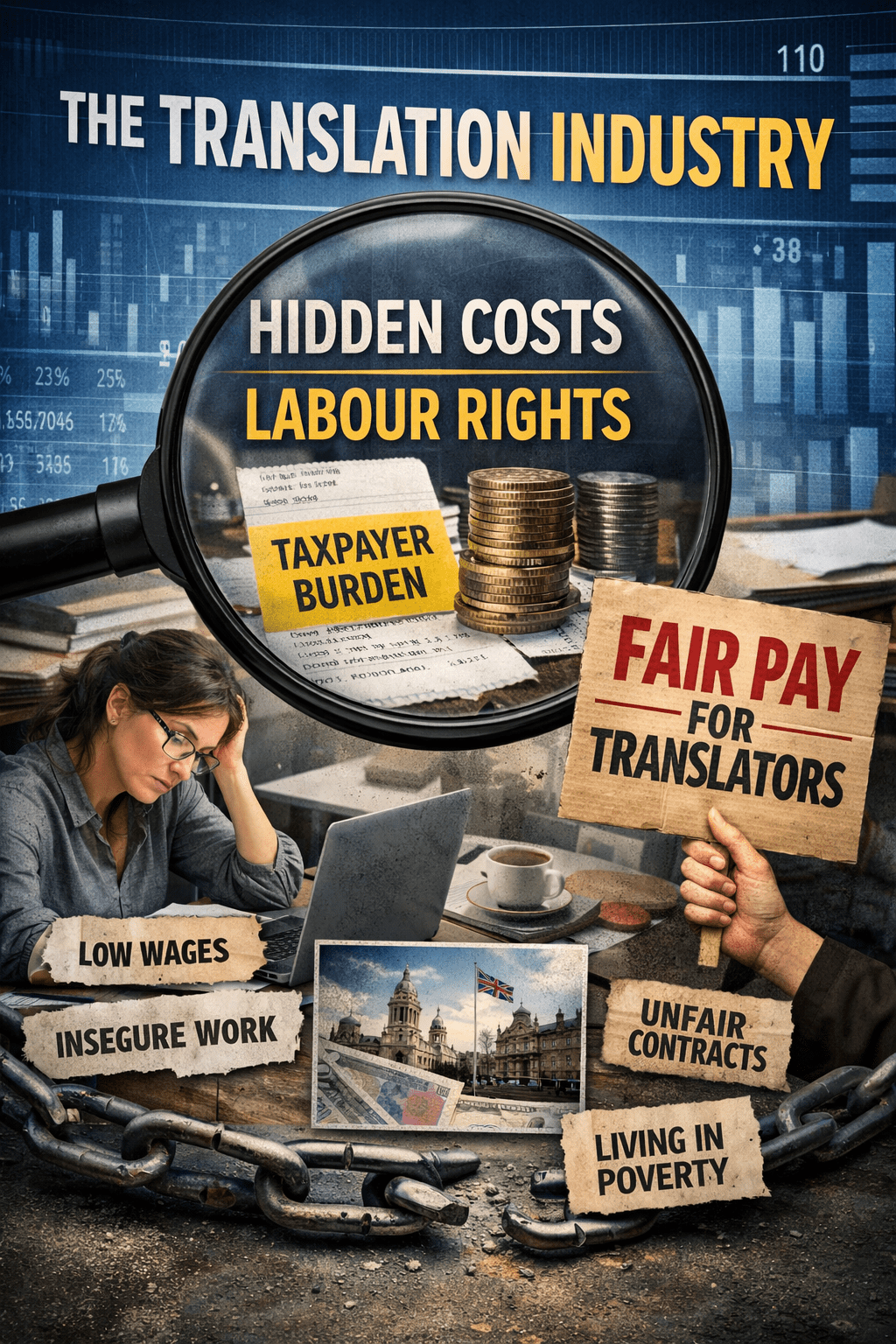
By Fardous Bahbouh, Researcher & Consultant on Labour Rights, Public Policy, and the Political Economy of the Translation Industry
The translation and interpreting industry is frequently celebrated as a multi-billion-pound economic success story. Yet behind these impressive figures lies a far less comfortable truth. Drawing on research into working conditions across the sector, it becomes clear that many translators and interpreters — the very professionals whose labour produces the service — struggle to earn a sustainable living. A growing number are forced to rely on relatives, personal debt, or even public support simply to survive. This raises a serious question about fairness, but also about basic rights. When highly skilled professionals cannot earn enough from their work to live with dignity or security, it signals a structural problem that extends beyond individual choices or career decisions.
The consequences reach further than the workforce itself. When linguists are unable to meet basic living costs through their professional earnings, part of the industry’s labour costs is effectively shifted onto society through tax-funded support systems. At the same time, language service providers (LSPs) continue to extract significant value from this labour through complex contracting structures. The result is a paradox: a sector presented as economically thriving while many of its essential workers remain financially vulnerable.
Industry reports — and, at times, academic texts — often focus heavily on the overall market value and growth potential of the sector. While these figures are not inaccurate, they tell only part of the story. My research, alongside a growing body of scholarship examining precarious labour markets, suggests that concentrating solely on turnover risks normalising a labour model that generates considerable revenue while distributing its benefits unevenly and transferring part of its social and economic costs to the public. If we want to understand the true impact of the translation and interpreting industry, we must look beyond headline growth figures and examine how its wealth is shared, who bears its risks, and what long-term consequences its employment structures create. As investigative journalists frequently remind us, meaningful accountability begins by following the money.
Industry reports regularly estimate the UK translation market alone to be worth over £2 billion annually, while global estimates run into the many billions. These figures are frequently used to portray the sector as dynamic, resilient, and economically valuable. They are also deployed to justify public procurement models based on outsourcing, as well as public investment in expanding “talent pipelines” to meet perceived labour shortages.
What these narratives obscure is how little of this market value trickles down those performing the core work. Empirical research into pay and working conditions in the sector demonstrates that a significant proportion of translators and interpreters are unable to sustain themselves through their professional income alone. Despite high levels of skill, responsibility, and linguistic expertise, many face low pay, irregular work, and limited bargaining power. These findings are consistent with wider research into outsourced and intermediary labour markets, where value extraction often occurs at multiple points between worker and client.
This has important economic implications. When skilled professionals cannot earn sufficient income from their labour, they may be compelled to rely on state support, including tax credits, housing benefit, or other forms of public assistance. From an economic perspective, this raises a fundamental issue: if a sector generates substantial private revenue while its workforce depends on public funds to survive, then part of its labour costs is being indirectly subsidised by taxpayers.
In this sense, the apparent profitability of the translation industry masks underlying labour rights violations as well as wider social costs. When translators and interpreters are not paid at rates that reflect the complexity, responsibility, and professional judgement their work requires, it raises fundamental concerns about fairness, dignity, and the right to earn a sustainable living through skilled labour. The resulting reliance on public support is therefore not the core problem but a downstream consequence of these structural inequalities. If linguists were fairly remunerated, dependence on state support could be significantly reduced. A fairly paid workforce would also contribute more consistently to tax revenues, creating a more sustainable and equitable economic cycle. These issues extend beyond labour market dynamics and raise broader questions about how economic value is distributed within knowledge-based industries.
The costs are not only fiscal. Precarious employment carries well-documented social and psychological consequences. Research across labour studies and occupational health shows strong links between income insecurity and increased stress, anxiety, burnout, long-term health problems, and even reduced life expectancies. Within the translation and interpreting professions, precariousness can also result in professional isolation, constrained career development, and underinvestment in skills and expertise. These patterns raise important questions about the long-term sustainability of a profession that underpins vital public services, including justice, healthcare, and immigration systems.
These pressures do not remain confined to individual workers. Over time, they place additional strain on public services, including healthcare systems such as the NHS and wider social welfare infrastructure. Income insecurity within professional households is also associated with increased risks of child poverty, which has long-term implications for educational attainment, social mobility, and future workforce participation. From a policy perspective, precarious professional labour should therefore be understood not simply as a workplace issue but as a wider societal concern.
There is therefore a risk that reports promoting the translation industry as a success story — while simultaneously expanding the labour supply without addressing pay, procurement practices, and employment structures — may entrench rather than resolve these problems. Academic and policy discussions focused primarily on growth can unintentionally institutionalise precariousness by funnelling highly skilled workers into a market that cannot offer stable livelihoods.
A more honest assessment of the translation and interpreting industry must therefore consider not only its gross economic output but also its distributional outcomes and social externalities. Evidence-informed regulatory reform, changes to public procurement practices, and stronger labour protections could improve income stability for linguists while reducing the hidden public costs associated with precarious work.
Describing the UK translation industry as being worth over £2 billion may be factually accurate in terms of turnover. But if that figure is used to justify continued expansion of a labour model that leaves many practitioners financially insecure and reliant on public support, it presents a partial and misleading picture. A sector built on language — a foundation of justice, governance, healthcare, and democratic participation — should not depend on economic arrangements that undermine the dignity, security, and sustainability of those who make it possible.
 Lingua Media Connect
Leave a comment